Shinya Hashimoto Gives Up His Leg for the Sake of the G1 Climax
Shinya Hashimoto's ambition to win the G1 Climax for the first time runs through the expert legwork of Kazuo Yamazaki.

This is going to sound crazy, but I spent the first half of this match wondering if Kazuo Yamazaki and Shinya Hashimoto were gonna do something. Don’t get me wrong — it’s a pleasant enough example of the strong style/shoot style clash of ideologies, but part of my process on BIG EGG is to go into matches I’m new to cold, so I didn’t know a lot about Kazuo Yamazaki, and know virtually nothing about the lay of the land in New Japan Pro Wrestling in 1998. My first impression of Yamazaki was that he seemed out of place in the finals of the G1 Climax, this rather plain looking guy near the end of his career going up against the ace. You know how people watch AEW and say that a match is too obviously tilted towards the star that they can’t imagine the other guy winning, then they let the narrative they’ve built in their head about this become something that takes them out of the match, their way of looking at the metanarrative of a wrestling promotion’s booking become a self-fulfilling prophecy about the match?
I found myself doing that here, and the match suffered for it. It felt meandering. I paused it and went looking for context — what was it about Yamazaki? — without spoiling anything about the match. He was a former UWF wrestler. When he defected back to NJPW, he taught Yuji Nagata the intricacies of shoot style. But Yamazaki’s story is neither that of the invader nor the prodigal son trying to redeem himself. He wrestled Hashimoto plenty of times, including at the Tokyo Dome, and usually came out on the losing end. The G1 Climax’s format in 1998 was a single elimination tournament, and Yamazaki beat Tatsumi Fujinami, Kensuke Sasaki, and Masahiro Chono in relatively short matches, storming his way into the finals one year after being put out in the first round by Hashimoto. A cinderella story of sorts, with his opponent looking to not only maintain his edge in their rivalry, but clinch the G1 Climax for the first time.
Interesting. I press play. Kazuo Yamazaki throws a low wheel kick and catches Hashimoto on the kneecap, causing the three-time IWGP Heavyweight Champion to cry in agony as his knee buckles to the canvas. I’m in. Not only am I in, but my misgivings about the match, my wandering mind, the time I spent pouring through archives and match results to establish some semblance of context for myself without spoiling what happens from bell to bell, all of it is burned away in the white hot fire of struggle.
It had, for the record, been smoldering the whole time. Early in the match, when Hash and Yamazaki are circling each other, Yamazaki checks Hashimoto’s legs with a couple of kicks, probing at an extremity to see if it presents a vulnerability. It’s early, but after the second kick Hashimoto is quick to fire back with one of his own, suggesting that this may indeed be a limb worth exploiting. Then Hashimoto backs Yamazaki into the corner and chops him as hard as he can right where the neck meets the shoulders, sending him to the floor. Hashimoto has powerful legs, but that chop just floors him. If you’re a technical wrestler, a master of shoot-style wrestling, what do you do in this situation: keep going after the limb you knew would be a problem going into the match, or go after the weapon your opponent has just revealed to you in retaliation?
Yamazaki opts to stick with the leg, but when he returns to the ring, he feints as if his focus has shifted to Hashimoto’s upper body. He’s interested in lock-ups, his kicks drift above Hashimoto’s beltline, and he’s on guard, early, against the DDT. But then he lands a kick to the knee and keeps going, trying to wear Hashimoto out before he can retaliate. It works — you can see Hash working kinks out of his leg every time he returns fire with one — but the shots he has to take in order to make that strategy effective are still monstrous. He feints high again, then throws the wheel kick. The fire isn’t smoldering anymore, it’s a full-on blaze.
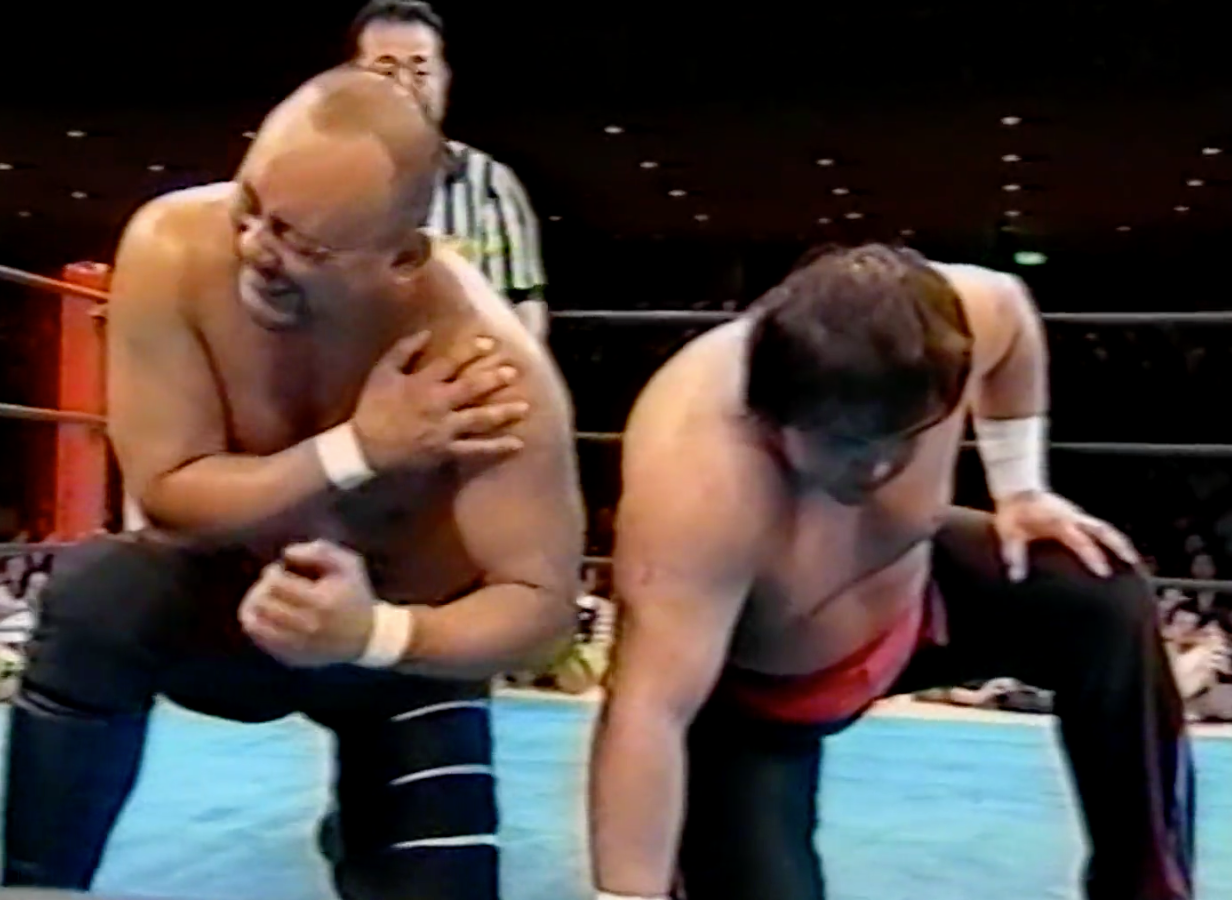
From his knees, Hashimoto can still throw his chop. When it lands, the blow freezes Yamazaki, who has to rotate his shoulder to get the feeling back into it, allowing Hash to chop him to the mat with a blow to the chest. I imagine that a lot of praise for this match ends up focusing on Hashimoto’s ability to sell the leg, and Yamazaki’s tenacity in working it, but what got me into it to this degree is Yamazaki’s shoulder selling — who the fuck sells their shoulder at all, let alone convincingly? So much limbwork in wrestling functions because you, the viewer, are being told that it does — the announcer cries out about a picked ankle, a wrestler yells “AWW MY BACK” when they land on their back — and it’s not like Yamazaki is doing anything different than anyone else, least of all Hashimoto, but you rarely see a wrestler clutch his shoulder to sell the effectiveness of something as simple as a chop. It looks like he’s been hurt, and his offense shifts to compensate that as well, as he throws himself head-first at Hashimoto’s knee like a wounded animal, anything to put the other man down.
And there you have it: Yamazaki’s kicks to the Hashimoto’s legs against Hashimoto’s chops to Yamazaki’s shoulder. The genius of their approach is that while both attacks could clearly win either man the match, neither of them make the other less effective — it’s a question of endurance, and if Hashimoto’s raw power makes it seem as if it’s still his match to lose, there is the question of what he’s supposed to do when Yamazaki’s not at chopping height. The answer, unfortunately for Hashimoto, is kicks, and it’s arguable that those take more out of him than they do Yamazaki, even when they send him flying across the ring. Hash’s gamey leg makes him slow to capitalize on a surprise DDT, and leave an opening for Yamazaki to begin diversifying his offensive attack, further wrenching away at his knee with the dragon screw leg whip and a knee bar. Now Hashimoto isn’t fighting to clinch the G1, he’s fighting to survive.
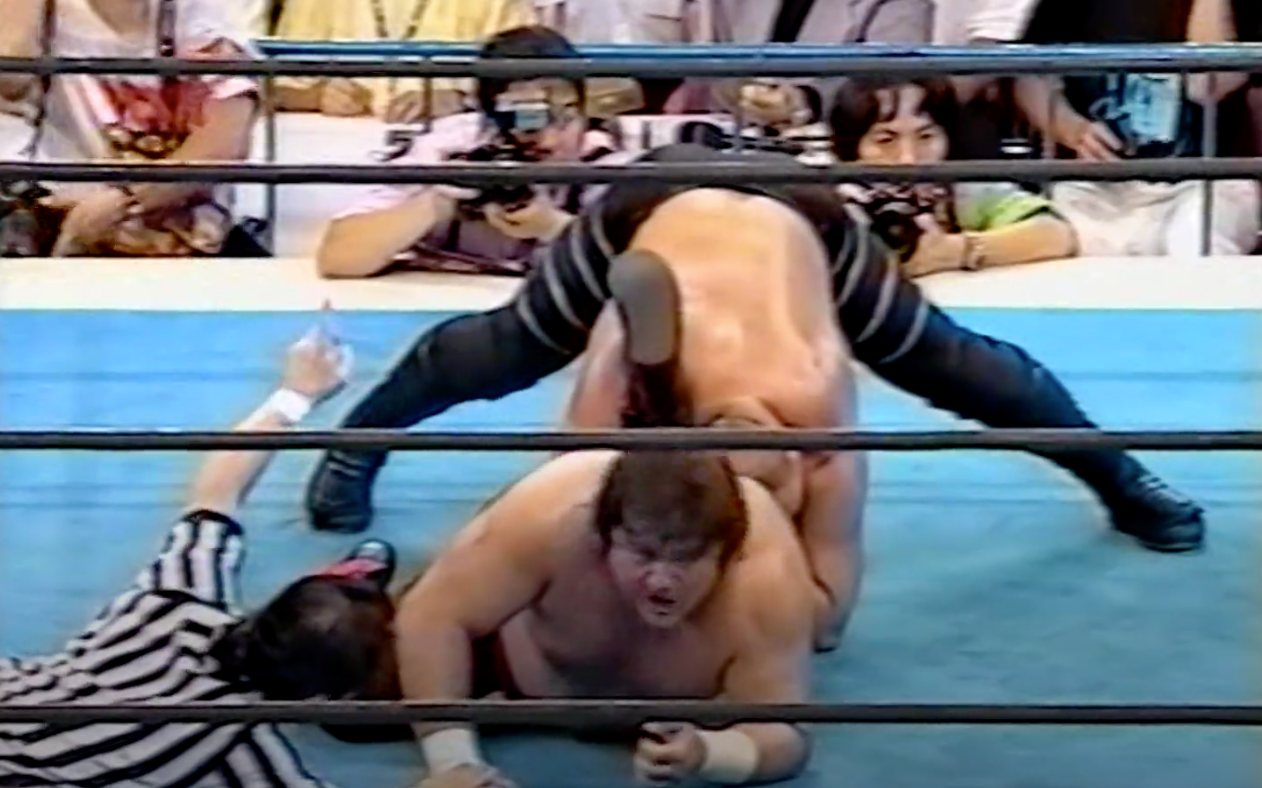
From here, things become about risk vs. reward. Hashimoto is in pain, his chops don’t seem to be as effective as they were earlier, so he tries to go back to the kick, a risk. It’s a stupid one, as Yamazaki catches it and turns Hash into a deathlock, the simplest version of the deathlock imaginable, planting his legs as wide as he can to exert as much pressure as possible with his uninjured shoulder, trying to make it hard for Hashimoto to move to the ropes. Hash looks like he’s had all of the air driven out of his body, but he’s a willful enough bastard to make it to the ropes, to desperately go for an enziguri, a reverse DDT, and a top rope elbow drop, risk after risk after risk, all of them landing, but it’s not enough to put Yamazaki away. The brainbuster is though, and with it Hashimoto finally clinches the G1 Climax.
When the bell rings, I find my mind wandering a bit again. This is a match that opened itself up to me about midway through, at which point the early match choices made by both Yamazaki and Hashimoto made sense and snapped into focus. The finish I am less enthused about. The overwhelming surge of big bombs is cool and all, you can wave off their success as a matter of Hashimoto’s adrenaline rushing when the match was otherwise lost to him, but this dude’s leg was fucked up and barely able to stand before landing his final four moves, three of which require the leg for peak effectiveness. I think what I wanted from the finish, having been given so much of it in the match’s middle act, was a payoff that involved their earlier choices, whether that’s Hashimoto’s legs buckling as he climbed the turnbuckles or tried to hoist Yamazaki up for the brainbuster, or his having to go with a different move altogether to win, like the spinning backchop he lands earlier in the match.
I am being unfair, as Hashimoto’s onslaught achieves what he and Yamazaki set out to do here in giving the beloved ace a dramatic win in a setting where he’s otherwise only experienced bitter disappointment, but because both men were so great about the cumulative damage of the tournament and their opponent’s choice of a target — Yamazaki’s shoulder, y’all! — I have to hold them to their own standard, which they fall a little short of. It’s a thrilling contest and an incredible moment in time … and it’s also a touch disappointing, a great match that doesn’t quite transcend the bounds of being a professional wrestling bout when, for a moment, it seemed like it would.
Rating: **** & ¼