In the Middle of Their Never Ending Story, Tatsumi Fujinami Triumphs Over Riki Choshu
Tatsumi Fujinami had to lose his footing in order to truly scale the mountain in NJPW.

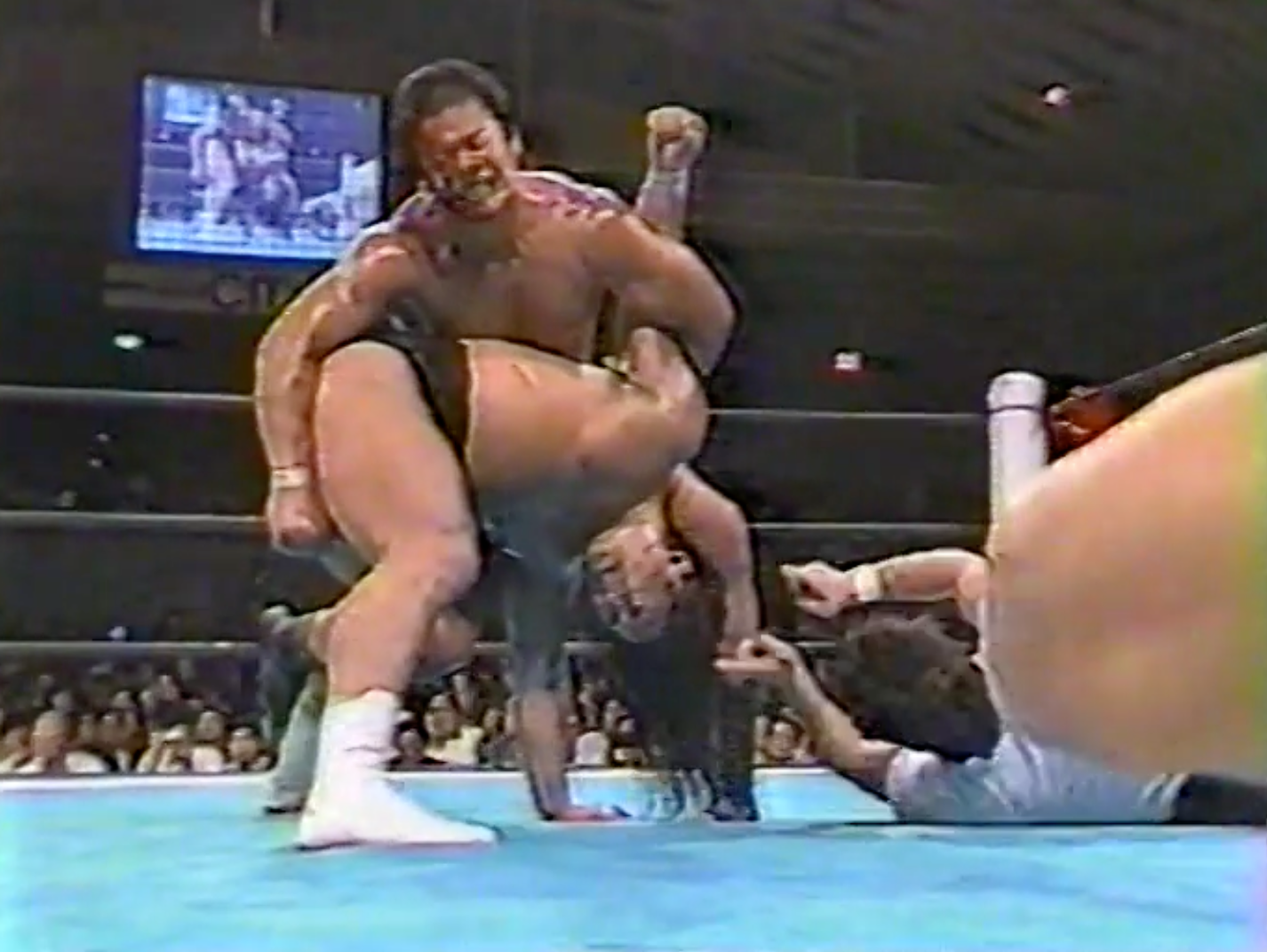
My first impulse is to ask why Riki Choshu doesn’t go after Tatsumi Fujinami’s leg. Just a few weeks prior to this match, Choshu and Fujinami wrestled to one of the sport’s great non-finishes when, as if by freak accident, Fujinami injured his knee and ankle so badly that the match was thrown out. Choshu didn’t win and Fujinami didn’t lose, but the fact that the IWGP Heavyweight Champion couldn’t finish the match necessitated the title be held up. Fujinami’s dogs were barking so loud in that match that he had to take off his boot and fight through the pain, something typical wrestling logic suggests would be an issue in a rematch, particularly with the title on the line. So, why does he forego it entirely?
 Colette Arrand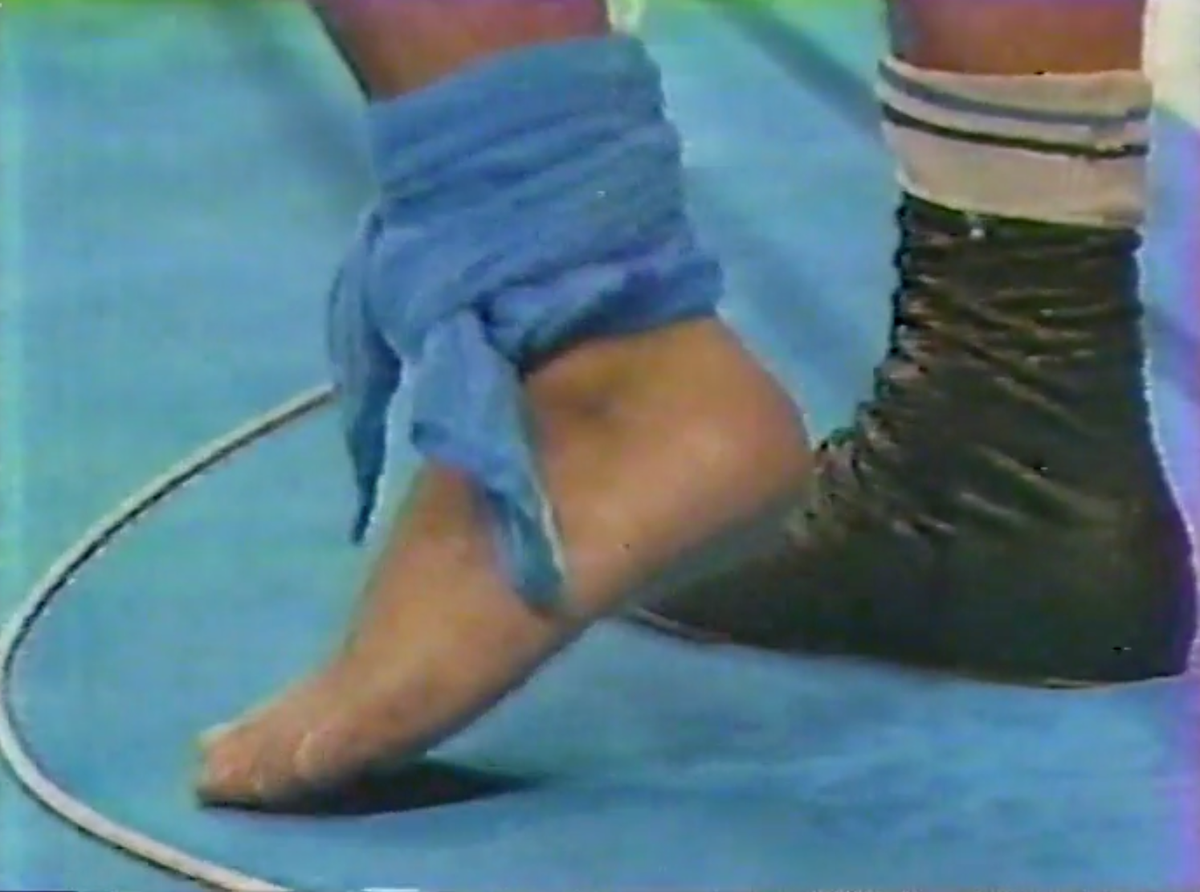
Maybe it’s a matter of medical science. Maybe Choshu made a mistake in his gameplan. Or maybe, as my assumption here would have it, the broader point of the match demanded something altogether different than targeted limbwork. If you listen to the commentary, one of the bits of English that sticks out is that, on multiple occasions, the issue between Choshu and Fujinami (or maybe the lineage of the still relatively young IWGP Heavyweight Championship) is referred to as a “never ending story.” The commentator has no idea how correct he was — according to Cagematch, which is comprehensive but hardly complete, this is the 235th time the two had shared a ring in some configuration since 1978, just a little beyond the halfway mark of their 520 recorded encounters, and while this is their last singles match until 1990, there are five tag team matches between their 5/27 bout and this one, all of them won by Choshu, one of which was for the IWGP Tag Team Championship.
The story here is not Tatsumi Fujinami’s injury, it’s about how Riki Choshu has him up against the wall, how Fujinami not only needs to prove himself to regain his championship, but how, to do so, he must prove himself to be his chief rival’s better. Choshu’s strategy changes not because he’s made an error in judgement, but because he enters this match with the decided psychological edge — even without the title around his waist, it feels like rather than Choshu needing to prove himself after returning to New Japan, Fujinami needs to prove himself to Choshu and the world at large. The difference in how the early match unfolds is particularly illustrative of this change of dynamic: where Choshu tried to fuck with the Dragon before the bell in May, getting under his skin by slapping him before the bell, here he’s focused, amping himself up in the corner, a champion in his mind if not in the record books.
He comes roaring out of the gate too, the first man to find an opening in what is otherwise a meeting of true equals, taking Fujinami down with a headscissors that he scores because Fujinami went just low enough for him to do so in blocking an attempt at a hip toss. The camera work on Choshu’s prolonged headscissors is phenomenal, showing the second-to-second struggle between he and the former champion, how he adjusts to each one of Fujinami’s adjustments, maintaining control, avoiding escapes. The first time I found myself leaning forward in watching this match was when Choshu blocked Fujinami’s attempted headstand escape by simply squeezing the Dragon’s head harder, his grunt of exertion cutting across the distance between the camera and the action, over the announcers and the early match murmurs of the crowd.
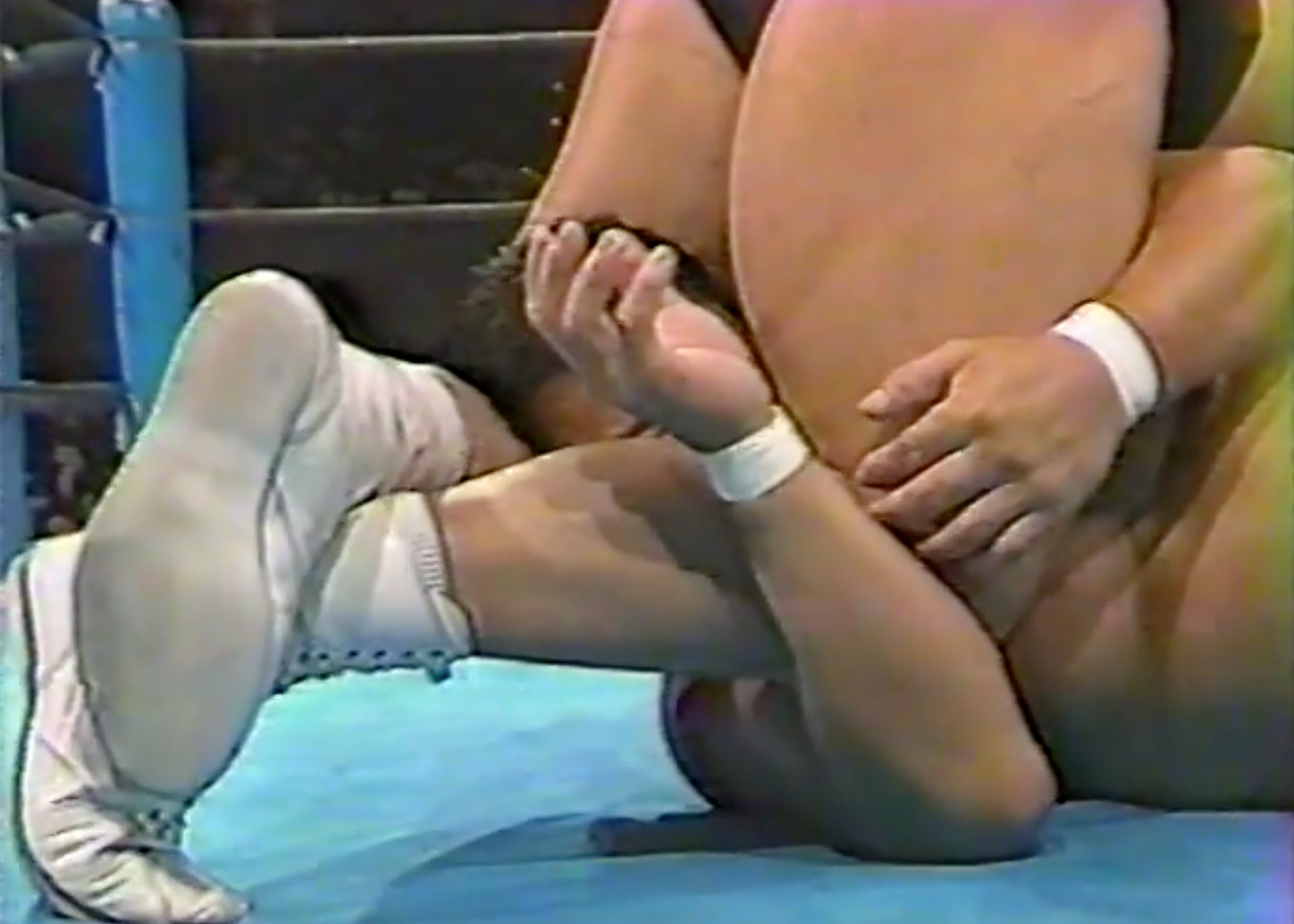
If the whole match was like this, two men reaching for holds and subtle escapes, I’d be riveted. Watching Fujinami find an escape route by trying to place his bodyweight on Choshu’s ankle, fail, and return to in a way that works is the kind of problem-solution wrestling that speaks to me, as is the follow-up sequence where Fujinami can feel his grip slipping on a headlock and transitions to a cravat. Again, the camerawork is exquisite. You can watch Fujinami lose and regain his grip, see Choshu strain against it, trying to escape by going down to the mat and twisting away from it before getting back to equal footing and finding the ropes. The brief bursts of action — Fujinami’s slap to the ear, their exchange of running shoulder blocks and knee strikes — pop even louder against the relative tranquility of their grappling-based struggle.
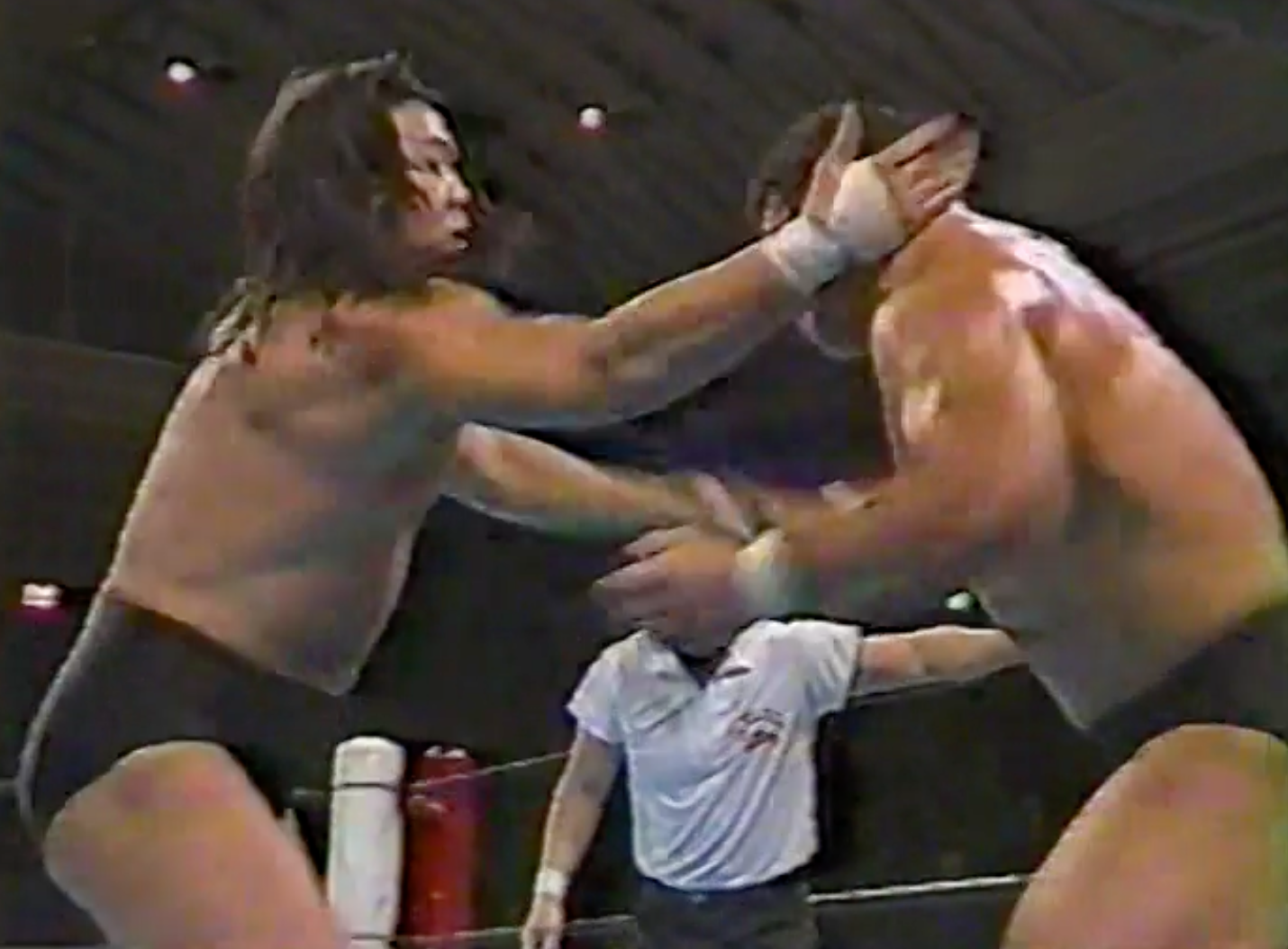
They quickly go into second gear from there, Choshu hitting Fujinami with an all-time motherfucker of a running powerslam, changing the tone as he once again tries to establish control via the headscissors. This time, it doesn’t work. Choshu figures that out quickly enough when he finds himself in a bow and arrow. Returning to the ring after escaping to the floor, he fakes Fujinami out on a test of strength by slapping him directly on his cauliflowered ear. His instincts in this part of the match are great — I love his flow from a fireman’s carry into a cross armbreaker — poking and prodding at all of Fujinami’s extremities and forcing the Dragon to find a way out, sometimes by taking the rope break, at which point he gets up and continues to pour it on with some mean looking stomps.
His mistake is believing that Fujinami won’t pull the same trick, to attack him instead of going for a test of strength. The Dragon catches Choshu in the stomach, then chips away at the legs, taking him off of his base and onto the mat. Things aren’t as dire for Choshu as they were for Fujinami one month prior, but he does not have as much of an advantage as he’d assumed, and halfway through the match Fujinami is not as willing to play nice about things like clean breaks as he once was. Choshu fires back with a kneebreaker, as if the target his leg presented moments before was a red herring, but when he goes for the Power Lock he struggles for a moment to turn it over and does not have enough strength in his legs to keep Fujinami in the center of the ring. Another gift of the strong camerawork is watching Choshu shift his weight from leg to leg after another pair of stomps — he’s not shaking the pain off anymore, but he’s not comfortable, and when Fujinami turns a Choshu headlock into a sudden backbreaker, it’s because Choshu can’t ground himself the way you’d want to when executing a headlock in a standing position — he’s all upper body now, and after a backbreaker, who knows how long that will remain true.
Sensing the kill, Fujinami goes for the Dragon Sleeper, locking it in tight once and losing it to a rope break before struggling for a less effective second round where his leverage point starts at Choshu’s hairline. Choshu escapes (cue Stan Hansen calling him a long-haired weirdo) and has more left in the tank than Fujinami guesses, chasing him up the turnbuckles for a powerslam. Both men having reached into their quiver for some of their biggest bombs, Choshu gets desperate, winding up for a lariat within eyeshot of Fujinami, who counters with a dropkick. He’s feeling the effects of the match less and gets up first for another shot at the lariat, but Fujinami sees that coming and tries to counter it, only for the two to end up locked together, with the Dragon taking the bad end of things when their momentum sends him spilling out to the floor.
At every stage of this match, with each escalation in pace or the level of bomb thrown, Riki Choshu and Tatsumi Fujinami reaffirm that they are each other’s equal, that the difference between them, the difference between victory and defeat, is not just skill or attrition, but who is in the right position to take advantage when those two things meet in one spectacular collision or another. Choshu’s late-match pivot to the lariat pays off when he finally catches Fujinami with one, sending him careening into the guardrail and busting the Dragon open … but despite the violent impact and the blood flowing down Fujinami’s forehead, would it not have been better for Choshu had he landed the lariat in the ring where he could pin him? Instead, Fujinami gets to take his time getting into the ring, gets to plot out his strategy for a final encounter with Choshu, if not a second and third strategy on top of that. Choshu hits him with a vertical suplex, but rather than floating over for the pin or getting up to stomp Fujinami out, he sits up to think of what to do and settles once more on the lariat.
It doesn’t work. Worse than not working, it exposes that Choshu is at his mental limit, whereas the gears are still turning for Fujinami, who counters with a dropkick and goes for an octopus hold, leaking blood on Choshu’s abdomen as he cranks on it. His grip isn’t great and he’s losing blood, so Choshu takes him over with a hiplock, waving it off, but his bravado does not change the fact that he’s down to his last move, and that Fujinami has, at this point in the match if not their rivalry, thoroughly figured it out. He counters with a backslide, nearly wins, hits an enziguri and rolls Choshu into an inside cradle, nearly wins, then rolls him up a second time and finally, finally wins.
It’s a beautiful conclusion to an incredible match, the succession of basic pinning maneuvers calling back to the simplicity of both men’s opening gambits while showing off Fujinami’s working genius in keeping a dizzied, gassed Choshu off balance until that work pays off in the grandest possible fashion: with his being crowned the IWGP Heavyweight Champion once again. It doesn’t play off of the finish of their 5/27 match in the way wrestling has trained us to expect, instead opting to pay off a month’s worth of work that followed. Tatsumi Fujinami lost his footing in May and tumbled down the side of the mountain. Here, through persistence and force of will, he summits it again. His story with Riki Choshu isn’t over, but this is one of its peaks.
Rating: **** & 1/2