Goldberg vs. Diamond Dallas Page Is WCW's Zenith
WCW might be the greatest wrestling promotion ever. This might be its greatest match.

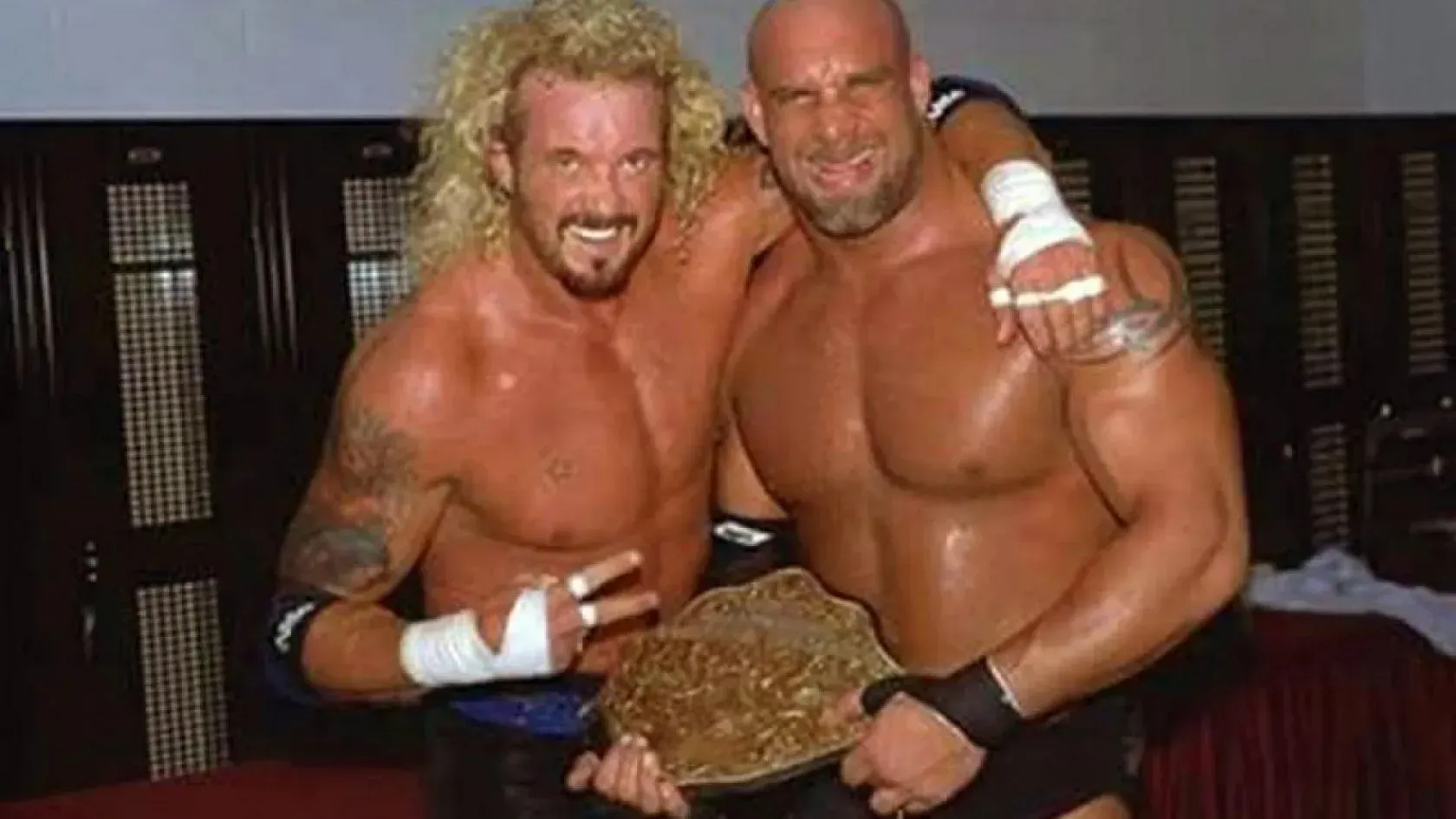
Goldberg. Diamond Dallas Page. Halloween Havoc 1998. How World Championship Wrestling arrived at this moment, a rare babyface vs. babyface superfight for the World Heavyweight Championship, is, like most things about WCW by this point in their history, extraordinarily convoluted. At Fall Brawl 1998, the company tinkered with the WarGames cagematch, doing away with the two teams of four concept and opting, instead, for three teams of three with the winner of the match beyond receiving a shot at the title. This was in the middle of the build for a WrestleMania VI rematch between Hulk Hogan and the Ultimate Warrior, as well as the feud between nWo Hollywood and the Wolfpac, as well as the neverending feud between Roddy Piper and Hogan, as well as the should-have-ended-at-Starrcade ‘97 beef between WCW and the nWo, and with all of that chaos swirling around, Diamond Dallas Page got lucky, as he so often did, and won an absolute shitter of a match.
Goldberg’s road was no less volatile. After winning the championship from Hogan on Nitro in August, his reign had largely consisted of semi-main events under a Hogan/DDP feud that involved Karl Malone and Jay Leno. In his lone run as the WCW Champion, he defended the championship fourteen times on television and pay-per-view. If that looks like a significant number, it isn’t: instead of facing top talent, Goldberg’s championship win and the need to have a hot segment on an episode of Nitro combined to make it so that the likes of Al Green, Scott Putski, and Rick Fuller were getting title shots when Curt Hennig, The Giant, and Meng were too busy to eat a Jackhammer. He has a great match against Sting on Nitro and revisits his issue with Raven on an episode of Thunder, but Goldberg’s title reign is so dire that Chris Jericho found success in going off reservation and insisting that he, as TV Champion, had a claim to being more important to WCW than the man he christened “Greenberg.” Almost as soon as they’d capped off a once-in-a-lifetime rookie year with one of the biggest victories in the history of television wrestling, all WCW could think to do with Goldberg was to insist that he was a flash in the pan.
That this became the largely-accepted narrative about Goldberg from December 27, 1998 to his retirement on July 12, 2025 (nearly 27 years to the day of Goldberg’s title win over Hogan on Nitro) represents a monumental fumble on the part of WCW, WWE, and everybody (with the exception of Bret Hart) who ever wrestled him and went on to whine about how the experience sucked because they didn’t win in spite of their obvious surplus of talent or some weird belief that you have to love professional wrestling to be good at it. He was the goose that laid golden eggs. Wrestling, unfortunately, is an industry that tells its fans that golden eggs are worth less than shit.
Diamond Dallas Page, having been around the block a few times, was too smart to dismiss a sensation like Goldberg out of hand. He did love professional wrestling, so much so that he did anything he could to be involved with it after blowing out his knee during his initial run at breaking into the industry in 1979. He was a grinder with a mind for the business, a sponge who had soaked up everything he could from the likes of Dusty Rhodes, Jake Roberts, Randy Savage, and everyone he’d ever stepped into the ring with, as a bum, as a midcarder, and as a household name. His meeting Goldberg at Halloween Havoc 1998 has a unique poetry to it, Page being the one guy who actually made it out of a thousand guys who were told they never would, Goldberg being the one guy out of hundreds like him who promoters salivate over due to their musculature and athleticism who actually made good on his potential.
Page was, to his eternal credit, smart enough to make this part of the one month run to this match, hammering home show after show that he knew that the odds, in Vegas and in the cosmic balance of things, were against him, that it would take everything he knew and an unreal amount of luck for him to dethrone the champion. But great wrestlers have a way of making luck where there seemingly is none. Page had two means of doing so: the Diamond Cutter — his finishing maneuver that’d sparked his own meteoric rise — and his being a student of the game. He watched tape on Goldberg, joined commentary and watched him work. He’d seen Goldberg dominate, he’d seen Goldberg get into deep water, and he knew, having run this man’s short career back and forth in his brain, that there was a hole in Goldberg’s armor — whether he could find and exploit it was the question of the match.
If you watch Goldberg’s streak back, you know the answer is yes. From time to time he’d run into a wrestler who pushed him out beyond his usual three to five minute range, who had something going for them that made it a little harder for Goldberg en route to tacking on another one in the win column, some combination of skill and experience and knowing how to win that separated them from the scores of bodies otherwise strewn around his feet. Actually telling the world this was both a psychological ploy and a promise that the main event of Halloween Havoc would be different from most Goldberg title defenses in that it was not only worthy of being a title defense, but would be worthy of both men, two unlikely phenomena who were as definitional to what World Championship Wrestling was as Sting and Ric Flair. It is another strange bit of poetry that on a card booked to give Hulk Hogan his revenge over the Ultimate Warrior, Diamond Dallas Page and Goldberg managed to conjure the strange magic of their WrestleMania VI classic: the twin thrill of feeling as if there’s something elicit in there being a rivalry between the company’s top babyfaces and not knowing for sure who the better man was.
When the bell rings, that tension explodes. Page, knowing he has a fucking mountain to climb, goes about the work of climbing a mountain. Close your eyes and listen to the fans as Goldberg rebuffs Page’s attempts to lock up with him. Consider, for a moment, that in bumping chests and tying up with one another a few times, these two men have managed to create this kind of atmosphere despite following one of the worst wrestling matches in the history of pay-per-view. Page can’t match Goldberg for power, but having tried and failed to do so three times, he changes strategy and takes Goldberg over with an armdrag before asking what Goldberg’s going to do about it. The answer is swift, as Goldberg rushes in and ties up with DDP with so much velocity that both of them fall through the ropes to the floor. Tony Schiavone posits that the lesson Diamond Dallas Page has learned from this exchange is to not go right at Goldberg, but he is, with all due respect, wrong: what he’s learned is that he has Goldberg off balance, that, rather than dictating the pace and flow of the match, Goldberg is responding to him.
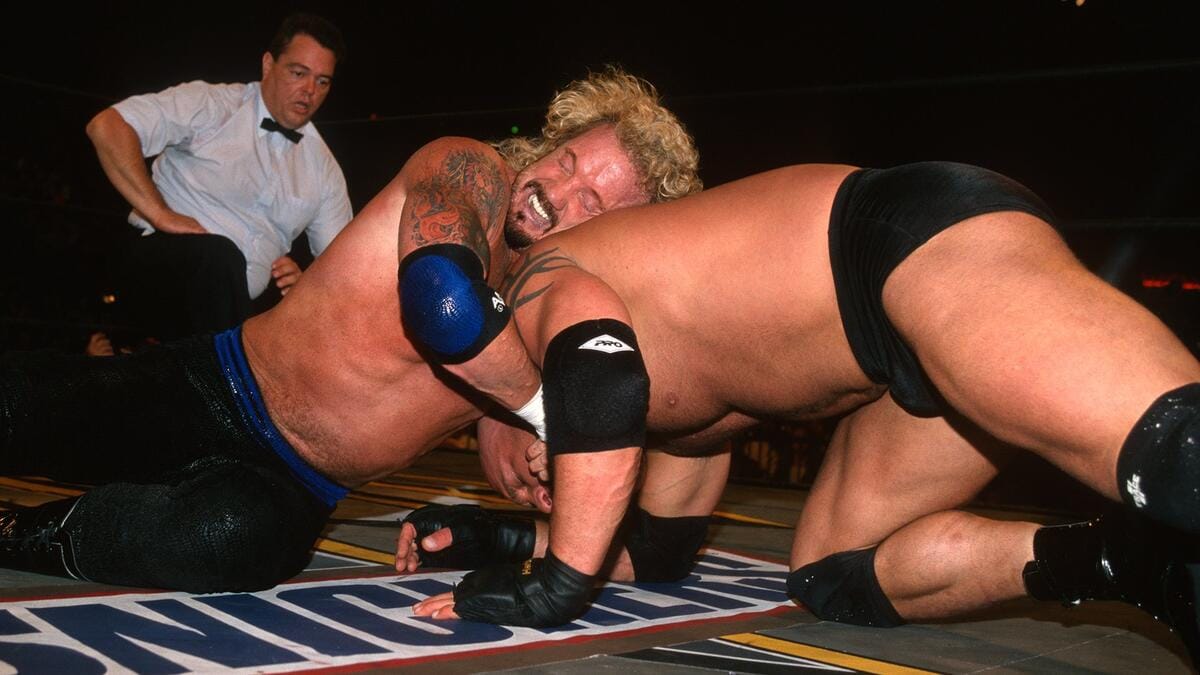
Page presses his luck, going back to the collar and elbow and transitioning it quickly to a headlock. Goldberg powers out. Page tries to sweep Goldberg’s leg but he breaks out a backflip and lands on his feet, so Page sweeps the leg again and succeeds. In a face/face match like this, one question that hangs over the proceedings is who will be the first wrestler to throw a strike. Here, surprisingly, it is Goldberg, who kicks Page in the gut when DDP goes for another tie-up. He also throws the first punch, and lands his first power move, a proto-Attitude Adjustment that he follows with a cross armbreaker. If it is part of Page’s plan to frustrate Goldberg, it is working, but to what end? Despite his success, Goldberg is still young, in there against a veteran. Goldberg is an explosive wrestler, but there’s a difference between blowing up on your opponent and quickening your pace out of anger. Page’s strategy, beyond surviving Goldberg’s power, is to chip away at Goldberg in the brief seconds where he loses his cool, to find a little daylight and catch the champion by surprise. He stuns Goldberg with a jawbreaker, rams his shoulder a few times, and goes for the Diamond Cutter. It’s nothing doing — Goldberg pushes him off and out of the ring — but he’s won something in the offing: not only has he started working on Goldberg’s neck and shoulder, but he’s planted a reminder that the Diamond Cutter can come from anywhere, at any time.
Page is full of surprises beyond the Diamond Cutter. When Goldberg tries to get back to wrestling, DDP escapes his grasp with some solid fundamentals. When he’s bounced to the outside again, he gets back up on the apron and snaps Goldberg’s neck over the top rope. Goldberg has wrestled plenty of men at this point in his career, but none of them with the exception of Sting have been so resilient, so determined to stay in the fight. Page keeps his foot on the gas, following up with a swinging neckbreaker. When Goldberg gets up, Page immediately goes for an Irish whip, getting full extension on Goldberg’s shoulder before pulling him back and whipping him into the other buckle to set up for a Russian leg sweep, scoring a rare two count on the champion while maintaining his focus on the neck and shoulder. When Goldberg kicks out, Page immediately applies a front facelock and forces Goldberg to fight back to his feet.
You are meant to be dazzled by Goldberg’s big moves, like his tornado of a spinning neckbreaker, but underneath these pyrotechnics Page is having the match of his life, literally and figuratively. For a month solid, he has claimed that he knows how to beat Goldberg, and in the opening five minutes he has come closer to doing so than anyone, even Hulk Hogan. Goldberg isn’t working heel here, but he is forced to work smarter and meaner than usual by Page, working on his famously injured ribs, punching him in the kidney, focusing his energy on the back and midsection, not because the spear and Jackhammer work the torso (nobody kicks out of the spear and Jackhammer, so “working towards it” is moot), but to slow Page down. It works until Page comes up with another surprise, a spinning headscissors counter to his second attempt at a sidewalk slam. Goldberg gets right back up and hits Page with a sidekick, hurtling him into the corner, and makes his move, going for the spear, only for Page to spring his trap, leaping over the champion and forcing him to ram his shoulder into the ring post.
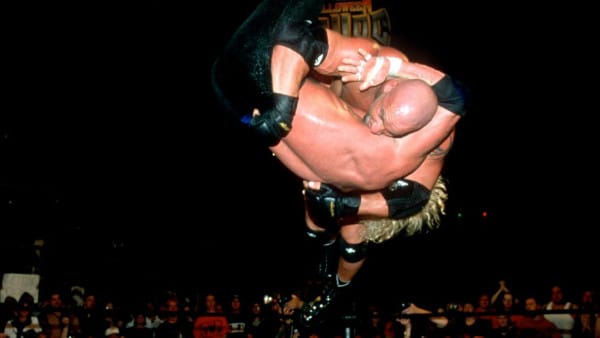
This isn’t enough to beat Goldberg, but it is the payoff to Page’s claim that he’d found Goldberg’s weakness, turning his own explosiveness against him after working diligently all match on the champion’s neck and shoulder. Goldberg, in a rare instance, has to sell and does so well, trying not to activate the shoulder while crawling back into the ring, where Page springs on him with a top rope clothesline for another two count. Goldberg continues to wrestle with one arm from here, reversing an Irish whip with his good arm and going for a hip toss without the ability to fully plant his weight or break his fall, allowing Page to hit him with his old Diamond Dream DDT. This prompts Page to make his first mistake of the match, signaling for the Diamond Cutter instead of just going for it, but when Goldberg spears him, it does as much damage to the champion as it does to the challenger. Page’s strategy and diligence have paid off, and do so again almost immediately: when Goldberg goes for the Jackhammer, he can’t lift Page. When he goes for it again, Page lands the Diamond Cutter.
They land maybe three feet apart, but that may as well be a chasm. The referee gets up to an eight count before Page makes the cover, then counts to two, and Goldberg kicks out, the first man to ever do so, but would he have done so if Page had made it over at Micky Jay’s seven, or had landed on top of him? If wrestling was real, this would be the sort of question that haunts Diamond Dallas Page, keeping him awake at night in spite of a long and successful career. Because it is not, one assumes he sleeps quite well, having found a means of letting Goldberg kick out of the Diamond Cutter while protecting the aura of his finish. Not knowing what to do, he brings Goldberg to his feet and tries for a suplex, only to have Goldberg shift his weight, counter, and use the momentum to lift Page into the Jackhammer, steeling himself against the pain of having to use his hurt shoulder before planting his challenger emphatically in the middle of the ring. When the bell rings he gets up to celebrate, but one of his arms doesn’t move. He has been in a war. He knows it. There will be more in his future, but none quite like this. It is, to quote Tony Schiavone, a remarkable match. To quote him again, my God, I love this sport.
Rating: *****