Against André the Giant, Antonio Inoki Chops Down a Mountain
In 1976, fresh from fighting Muhammad Ali, Antonio Inoki found himself proving that Strong Style was the strongest style against André the Giant.

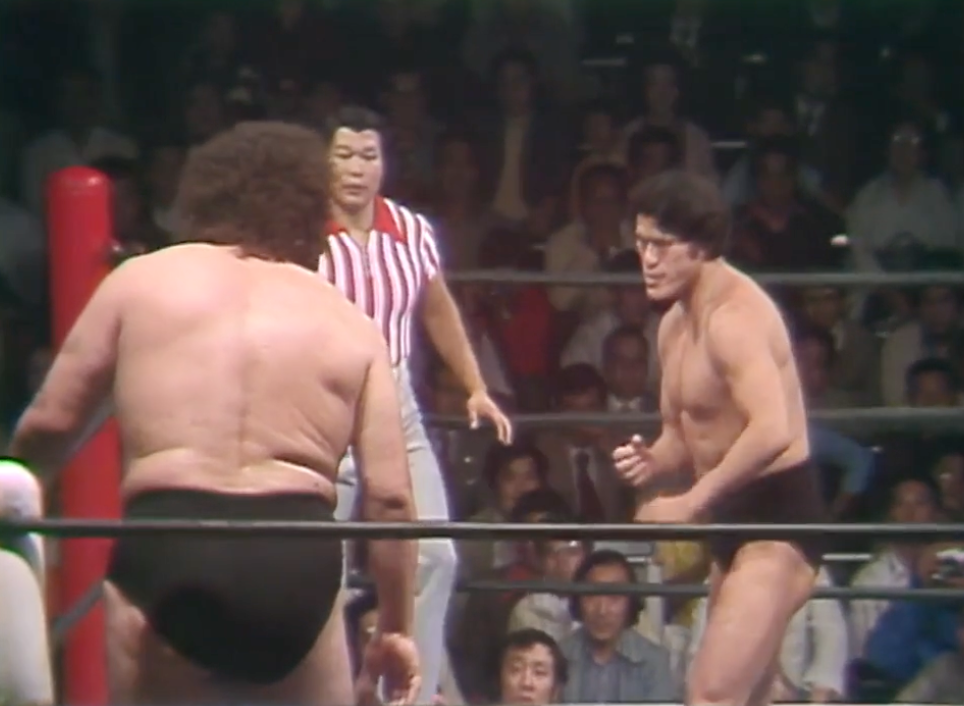
Generally speaking, I like to know as little as possible about wrestling matches of this vintage before I see them, but when you pull this match up on NJPW World and see the English translation of the video file — King of Mixed Martial Arts finals: Antonio Inoki vs. André the Giant — the mind reels. I know, having used NJPW World for years, that “final” means “main event,” but there’s the question of “King of Mixed Martial Arts” — what the fuck does that mean? Does it have anything to do with Antonio Inoki’s wrestler vs. boxer bout against Muhammad Ali, which had just happened three months prior?
“King of Mixed Martial Arts” is an incredible-sounding-but-incorrect translation for “Real World Martial Arts Champion,” a title Inoki created during the lead-in to his match against Ali, held at an event called “Real World Martial Arts Championship which ended in a 45-minute draw that prompted fans to cry for refunds and, despite the contest being real enough that Inoki’s infamous leg kicks caused blood clots and diminished Ali’s ability as a fighter, did not succeed in Inoki’s ambition to prove, despite any rumors about it’s being a work, that wrestling was the strongest style, the king of sports, and he its ultimate figure. Googling around these tidbits, I found my way to an excerpt from Chris Charlton’s Lion’s Pride: The Turbulent History of New Japan Pro Wrestling that further contextualized the championship.
From the book:
As Inoki embroiled himself in angle heavy feuds with Tiger Jeet Singh and The Sheik, he was also determined to protect the business of wrestling in Japan, as skepticism gradually eroded “kayfabe” in the West. Moreover, Inoki was determined to protect his particular brand of wrestling above all others, and especially that of a certain Mr. Baba.
NJPW, Inoki declared, was not merely the king of wrestling, but the King of Sports, a slogan created in early 1976, and still used by the promotion four decades later. In order to prove this, Inoki himself would spend the better part of 1876 wrestling with top athletes proficient in other martial arts.
Creating the Real World Martial Arts Championship, Inoki sought out prominent martial artists to face in worked bouts in order to further establish himself as an all-conquering superstar, and his company as the leading brand of wrestling. The end goal would be a June 25 bout with Muhammad Ali, arguably the greatest international sports figure at the time, which would see the boxing great put over Inoki strong with the world’s media watching.
Whatever Ali’s reasons were for taking the match, Inoki’s were pure professional wrestling: He created a championship to put on the line against Ali so that, once he defended it against the undisputed heavyweight boxing champion of the world, he would be globally recognized as the greatest fighter in the world; when the deal was renegotiated into a draw, Inoki kept the title and whatever prestige it still had after the fiasco it kicked up. That’s a fucking worker, y’all. I can’t not fuck with Antonio Inoki, he has too much swagger.
What does that have to do with this match? Not much, or maybe everything. What do you do if you’re Inoki, having theoretically proven the superiority of strong style by going the distance with Ali? Why not test yourself against the most pro wrestling-ass professional wrestler who’d ever lived. I know there are many, many arguments for other wrestlers, so far as such designations are concerned, but the more of André I see, the harder it is to deny. Look at him. Listen to any number of stories about him. Watch the footage. Whatever argument there is for his contemporaries, your Hogans and Flairs, men with towering careers and small lives, they pale by comparison. He’s young here, too — 30 years old, 10 years into the business — and while I don’t put a lot of credence in the whole “to really know André you need to see him when he could move” canard, it does give Inoki an astonishing point of reference to make his case for strong style as the King of Sports, better than Ali or any number of retired judokas he could conceivably coax into the ring to test himself against.
I love how this starts, Inoki trying his luck with a surprise dropkick, André shrugging it off, then Inoki trying to avoid the giant’s grip until he’s finally caught by the arm in a standing double wrist lock. André is all smiles until he catches Inoki, then he immediately changes gears mentally, setting himself to the task of grinding Inoki down. Everything about André is a challenge: Can Inoki escape his grip? Can he maintain a safe distance? Can he feel his arm? Can he get him in a waistlock? He can’t, and when André turns that last attempt at seizing control into one of his trademark hip attacks, Inoki’s cool breaks for a moment. He looks almost embarrassed to be the one on his ass. He pounds the mat in frustration. He gets back up. He looks for another solution.
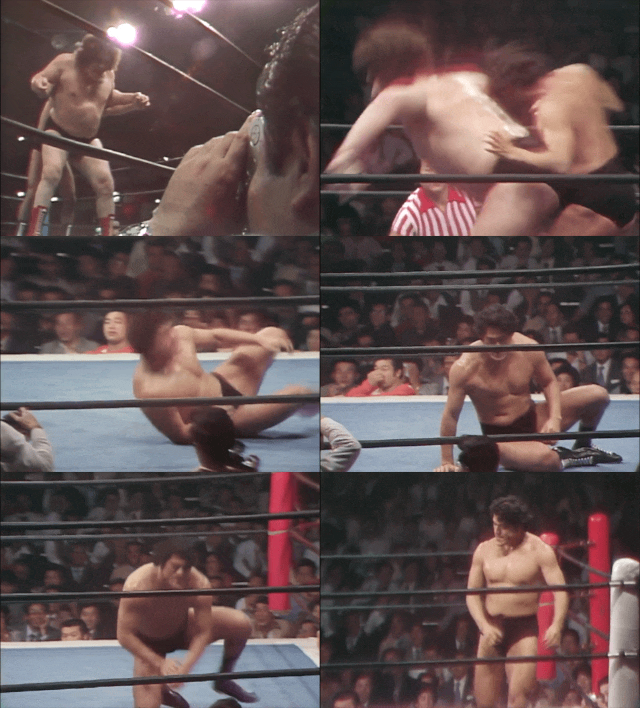
There are no easy ones. Antonio Inoki is by no mean a small man, but when André puts him in a chinlock, he completely engulfs Inoki. At last, he roars, popping his hips to take André to the mat, where he can assert himself, which he does with an arm scissors. This, more than any rote strike exchange in the last third of an overlong match between seeming equals, is fighting spirit. It feels right when André is overpowering Inoki — Antonio’s chin looks like it was designed to fit in the crook of his elbow — but through strong style, one can contravene the primordial forces of nature, even evolutionary biology.
There are bits and pieces of context that are lost to me through time and the language barrier — why, for instance, does the referee kick André’s hand off the top rope instead of calling for Inoki to break the scissors? — but when the follow-up is André countering by lifting Inoki onto his shoulder and dropping him onto the ropes, it is difficult to quibble. Both men have opened a hole in the other’s armor, and Inoki, knowing how precious time is against a man of André’s size, tries to take advantage first, kicking at the giant’s arm. André’s so good on the sell — this is one of those things that’s maybe not as apparent to viewers who are mostly familiar with his post-Hulkamania work, where he’s masking for how winded he is, but watch him recoil with each kick and progressively work to shield his wounded arm from Inoki, pulling it into his body and turning into the corner to minimize the target, eventually baiting Inoki into throwing a kick he can anticipate and catch. When he does, he has a choice to make: crush the leg he caught, or the one Inoki uses to plant with. In choosing the plant leg, which is the right move, he has to use the arm Inoki’s worked over. It hurts him. It hurts Inoki. We are back to square one.
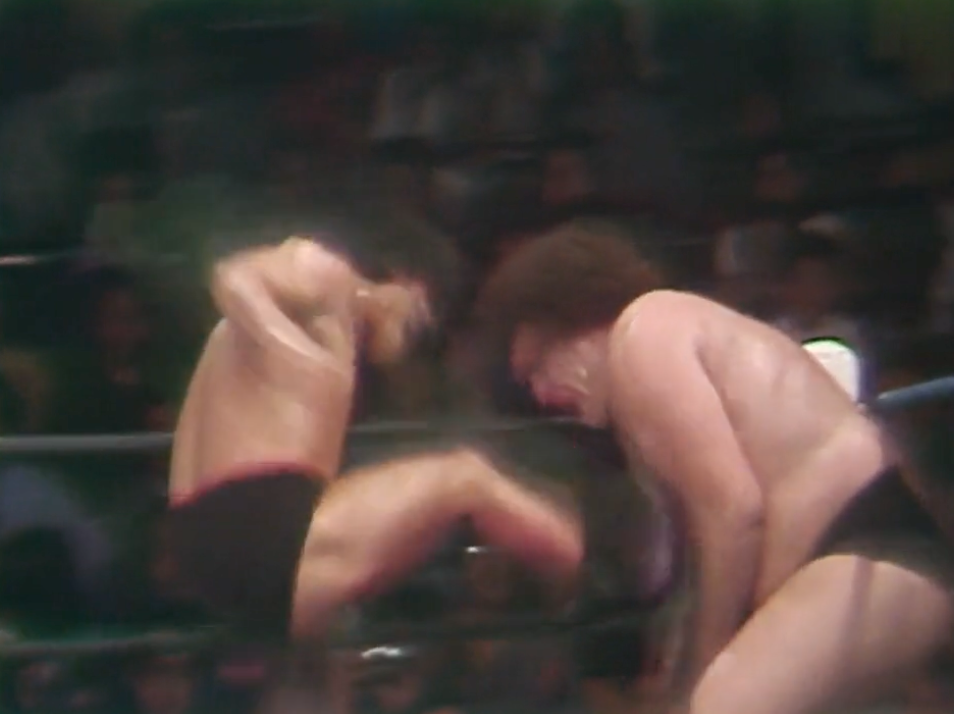
That’s the first act. The second begins when Inoki slaps André. It’s a calculated risk — there’s no question that André can out-punch Inoki, and he immediately balls up his massive fist and threatens to do so, but one of the oldest maxims in professional wrestling, even this far back in its history, is that an angry wrestler is liable to mistakes, to let their defenses slip in pursuit of a receipt. There’s an immediate payoff to this, as André corners Inoki, goes for an overhead blow, and, in breaking his grip on Inoki’s throat, lets him go just in time to punch the top turnbuckle. After bellowing in pain, he tries to slow things down, bending Inoki’s arms behind him and taking him to the mat, but the work Inoki’s put in on André’s arms bears even more fruit, as he’s slow in transitioning to his next attack and ends up in a headscissors.
André takes control again, cranking Inoki’s head sideways and landing some more signature big shots, like the jumping stump puller, but the balance of the match is slowly, painstakingly shifting towards Inoki. When the concept of “psychology” brought to bear upon the great sport of professional wrestling, it’s typically in reference to how a wrestler thinks through his attack, plotting out how they will exploit or create weaknesses by picking apart their opponent’s limbs and, usually, doing so slowly. It’s a cliche, rooted more in the need to constantly be saying something about a wrestling match as opposed to any real detail a wrestler puts into his work, but Antonio Inoki is a psychological wrestler. His career, his life was dedicated to his philosophy of professional wrestling, which he had organized so thoroughly and practiced so doggedly that said life and career looks like a series of contradictions until you realize that the throughline connecting it all isn’t wrestling, but Antonio Inoki.
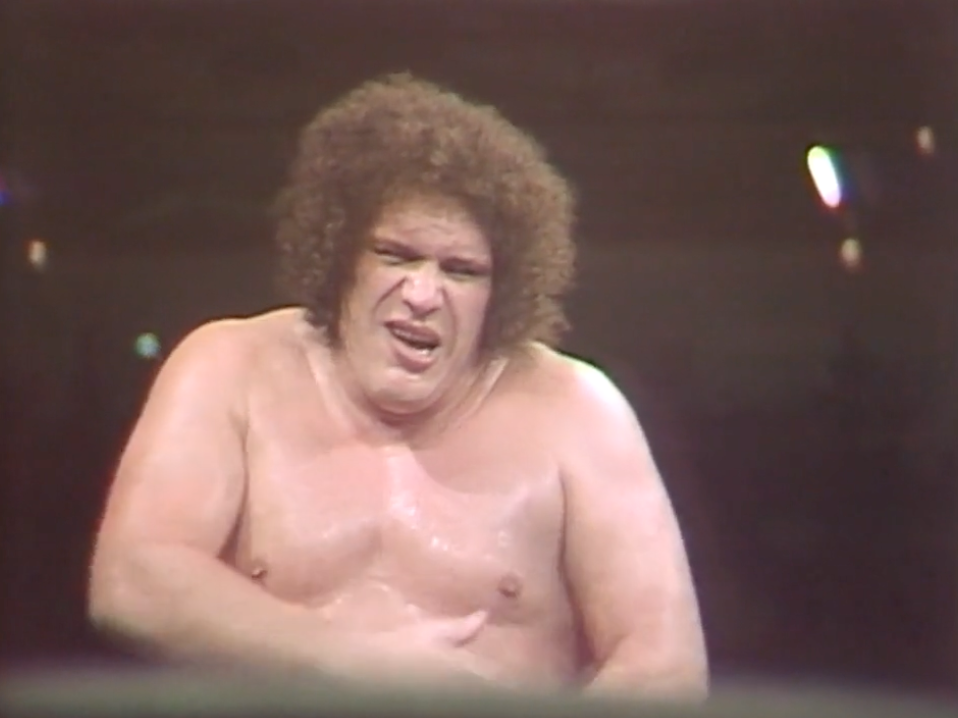
So let’s go back to the beginning here, when Inoki finds himself pounding the mat after taking the bulk of André’s bodyweight to his unprotected chest. How does he end up in this position, pounding the mat in frustration? By rushing. By flying at André the Giant with a dropkick and attempting to manipulate the limbs of a man of that size without putting in any of the work. There is a moment, early in the match, where you can hear André the Giant laughing as Inoki buzzes around him, as if the champion is doing most of the work for him. André the Giant is not someone you can blitz. He is a mountain, and mountains take time and persistence to erode. When Inoki slaps him, that’s Inoki seizing control of the situation, positing André as the challenger, the one with something to prove to him. André still catches Inoki, but you can see from his body language and his use of a closed fist that he is wounded and angry, that what Antonio Inoki is doing is working, that it will work, if Inoki can keep it going.
So Inoki makes sure that everything André the Giant does comes at a cost. In a leg log, Inoki grinds his forearm against André’s cheekbone, forcing him to shift from his favorable position in the center of the ring to one where Inoki can stretch out, enduring a less effective series of leglocks that ends with André executing a bow and arrow into the ropes, forcing the break Inoki had been seeking. Frustrated, he kicks Inoki out to the floor, which allows Inoki a chance to breathe and to cause further frustration, toying with an impatient André as he gets back into the ring. When they do, André hurls Inoki into the ropes, then takes his eye off of him to go for a back body drop, which Inoki counters with a dropkick to the neck. Unlike the first one Inoki threw at the bell, this one causes damage and allows him to go to work on his neck.
This is, in a word, brilliant. My quibble with the referee pops up again when he inserts himself, Earl Hebner-style, into things, kicking André’s hand off the rope he’s using to block an Irish whip, but the payoff is worth it again, as André reverses a second one, charges in after Inoki, and misses with a desperation headbutt, calling back to the earlier moment where he chopped the top turnbuckle, only this time he catches it with his face. This is not the end of André the Giant, but his displeasure leads to more unforced errors. If André the Giant has you in a leg lock, as he has had Antonio Inoki on several occasions, he has you until he’s ready to let go. Inoki encourages him to do so by chopping him in the forehead, which, calling back to Inoki’s first strike to his face, pisses André off to the point that he punches himself in the forehead to taunt the champion, not letting go of the leg, but relieving some of the pressure and forcing him to reassert his grip. When he does so, Inoki chops him in the forehead again, prompting André to let go, grab Inoki by the hair, an level him with another headbutt. There are consequences for Inoki in doing this, obviously, but a headbutt is not a one-victim attack, and André’s head has already met steel once in this match. The change in ring positioning made necessary by the headbutt puts Inoki closer to the ropes, so André puts out an arm to stop his progress, so Inoki takes it and puts him in an armbreaker, taking a free kick at André’s head to achieve full extension.
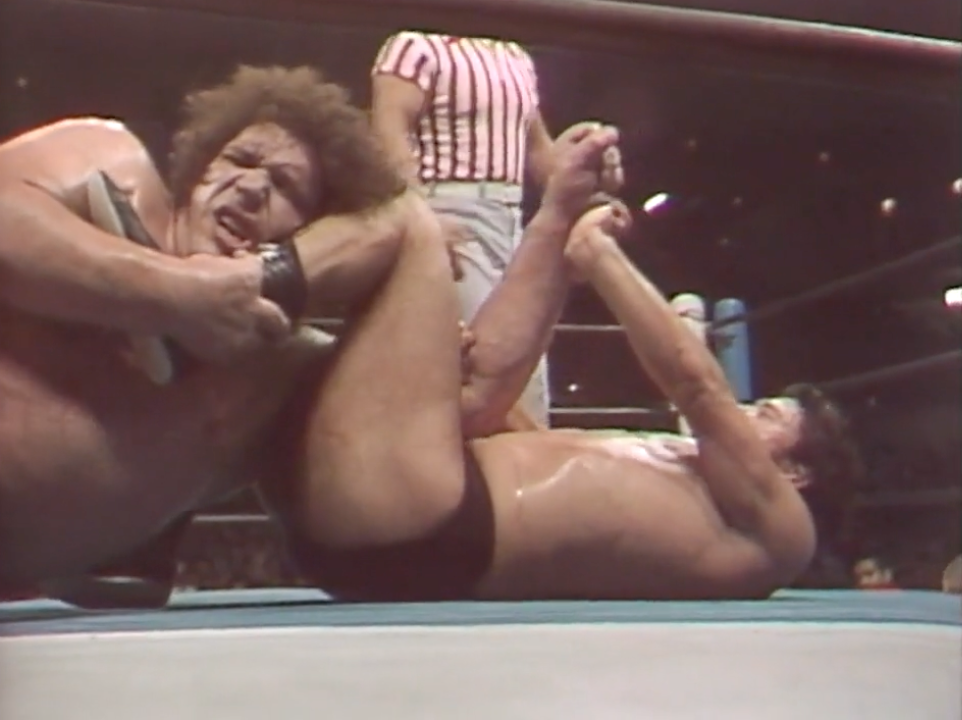
André has enough left in the tank to counter, but at this point he abandons decorum entirely, using the bottom rope to choke Inoki before locking in a sleeper. Inoki’s struggle against it is another series of small steps, elbowing and reaching out until he’s shuffled his burden close enough to grab the rope, which the referee admonishes him for not once, but twice, until Inoki leaps over the top rope with André still around his neck. André, for his part, pulls Inoki back into the ring over the top rope. The second time Inoki goes for this gambit, he has enough leverage to pull André over the top rope with him, a spectacular visual that would have probably blown the minds of the many, many American wrestling fans who knew André as the king of the over the top rope battle royale. Even on the floor, André is the pursuer, presumably still in better shape than Inoki, clutching the man’s leg and bringing him up to his feet against the ring post … which he immediately eats when Inoki ducks away from an incoming headbutt.
When both men get in the ring, André the Giant is bleeding. Inoki has spent 20 minutes needling at him, egging him on, and it’s finally borne visible fruit. He transitions from chops to closed fists to work the wound, which André responds to with a desperation grab, hoisting Inoki into the air for a Canadian backbreaker. Winded and losing blood, his ring positioning is off, and Inoki uses the top rope as a springboard to reverse it into an incredible-looking back body drop. For better or worse, this is effectively the end of the match as a bell-to-bell contest of wills. André gets to his feet, but he has blood in his eyes and a man punching at him freely, so he begins to swat at anyone in his periphery — Inoki, the referee, his manager who is just now involving himself in things. The referee has enough of this and throws the match out, awarding it to Inoki without André having to take the loss.
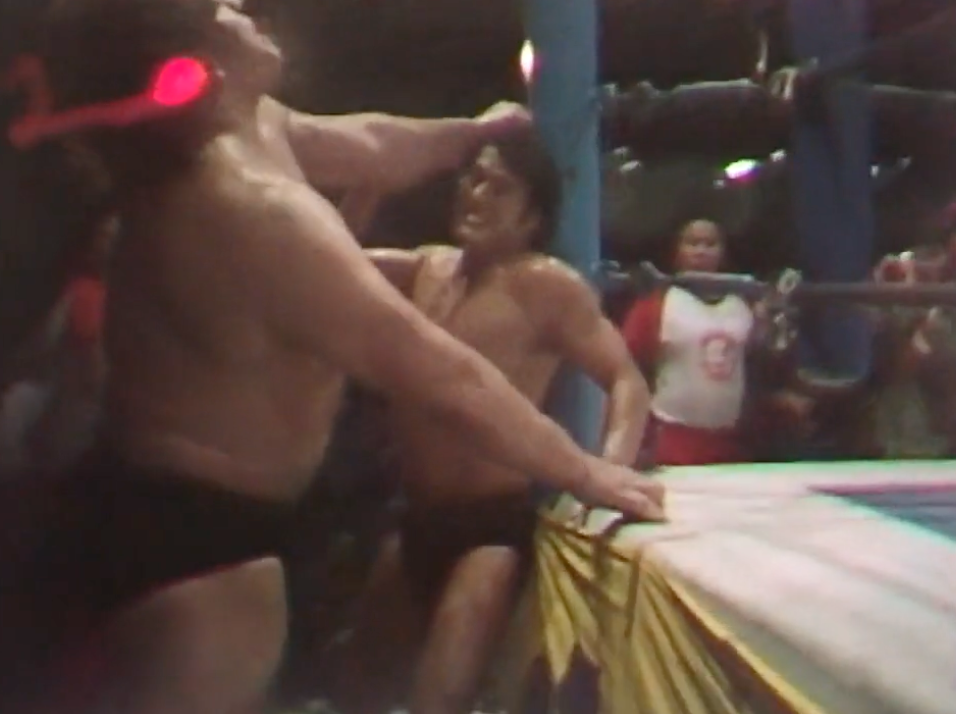
If that kind of thing bothers you — you know, the need to keep top acts strong so a match can continue to draw from town to town — I get it, but I love post-match brawls when they’re good, and the cat-and-mouse chase between André and Inoki, culminating in André taking a back body drop over the ropes, is good. With André refusing to leave the ring, Inoki chooses to continue the fight, taking a massive splash and getting kicked out of the ring. Having refused to yield to this point, Inoki climbs back into the ring, balls his fist, and asks the crowd if they want to see more. They do, and despite the protestations of André’s manager, so does he. Inoki’s refusal to take the win or the moral victory of André needing to choke him out despite André’s frothing rage is heroic, the kind of thing that makes a professional wrestler a folk hero, even when the result has the adoring crowd angry enough to throw their seat cushions into the ring. Antonio Inoki gets the win, but that’s not what he’s after. He wants to prove that strong style is, true to its name, the strongest, not merely strong enough to survive. Many such chances to do so await him in the future, but tonight, much like when he faced Ali, his quest lies unfinished. Unlike the Ali bout, the way it resolves makes you want to see this man attempt to scale the mountain again. That’s Ace shit, baby, and so is this match.
Rating: **** & ¼