Rey Mysterio vs. Psychosis: Lucha Libre WCW Style
July 7, 1996 is a really important day in wrestling history, and you know why: The Carson City Silver Dollar Pole Match ... and Rey/Psychosis.

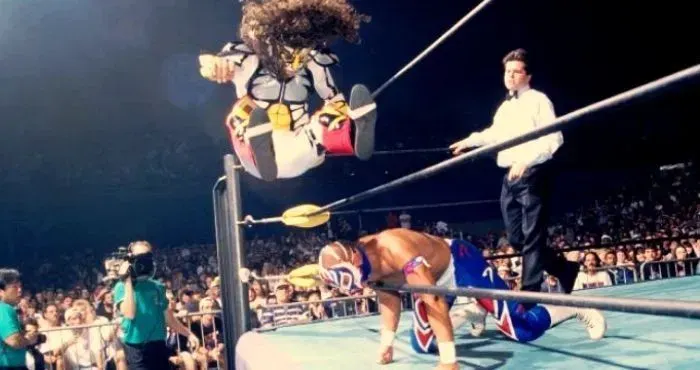
July 7, 1996 is one of the most important dates in the history of professional wrestling. Most of the time, statements like that are hyperbole, but most wrestling shows do not feature a reveal like the one at the end of WCW’s Bash at the Beach, that Hulk Hogan, after 12 years on top of the industry as its top babyface wrestler, was the mystery third man, joining Scott Hall and Kevin Nash to form the new World order. The idea that a wrestler can sell out an arena on a rumor is a fun one, but this is something else: the question of Hall and Nash’s unannounced partner drew a sellout at Daytona Beach’s Ocean Center, and an exceptional 250,000 PPV buys. The reveal solidified WCW’s place atop the wrestling world for a time, then crashed WCW, then became a stable source of licensing income for WWE, as well as a foundational wrestling angle that promoters will pull from long after you and I and everyone we know are long gone.
July 7, 1996 was also the day WCW’s cruiserweight division found its identity.
To this point, the division and its championship felt mostly like a nice thing to do, both for the smaller wrestlers WCW had signed from ECW — Dean Malenko, Chris Benoit, and Eddy Guerrero — and for New Japan Pro Wrestling, their partner promotion whose red hot junior heavyweight division had nothing mirroring it in the United States. The first champion, Shinjiro Otani, beat Chris Benoit in the finals of a phantom tournament at NJPW’s Hyper Battle 1996, then lost the title to Dean Malenko on an episode of WCW Worldwide as WCW shrugged off their half-ass attempt at building a division by backfilling a tournament in syndication.
I wouldn’t call this a typical WCW mess, but only because their competition was just as unfocused — see the WWF’s attempt at launching a light heavyweight division of their own. But you can’t deny that Eric Bischoff had no idea what the fuck he was doing here: Otani’s lone defense of the title was his five minute loss to Malenko, who then defended the title against Brad Armstrong, “Hardwork” Bobby Walker, and the goddamn Disco Inferno. Oh yeah, and a guy by the name of Rey Mysterio Jr.
The first two of Malenko/Mysterio matches of 1996 represented the following for the then-21 year old luchador: his WCW debut, his PPV debut, and his national television debut. The third, which happens on the Nitro following this show, is his first championship win. They are important matches, all three of them, and I have a fondness for Dean Malenko that neither time nor taste has managed to tarnish as of 2026, but I do not think I am alone in thinking that it’s this match, Rey Mysterio Jr. vs. Psychosis, that was the division’s first true signature match, the one that opened the floodgates for their fellow luchadors and established what a cruiserweight match should be — like if the Pillman/Liger SuperBrawl II classic had been followed up by an actual, honest-to-god attempt at establishing a division and creating stars within it.
If you strip away all of that context, if you can somehow manage to ignore the crowd learning in real time about wrestling cultures that are not their own, the match itself loses none of its shine. It just smokes: two long-term rivals using their knowledge of each other and the global stage afforded to them to crush a towering home run, topping everything in their considerable catalog and changing the trajectory of both of their careers — especially Rey’s. For 15 minutes on pay-per-view, he and Psychosis create a bubble in which they’re the only two wrestlers in the world who matter. Add all of that context about Bash at the Beach 1996 back in and, the knowledge that this is one of the most consequential evenings of professional wrestling ever, and that is still true.
But the thing that I like the most about this match is how it serves as an education. The weight wrestling fans place on opening matches is largely the narcissism of home viewing. Whatever the fans in Daytona Beach knew about Mysterio and Psychosis, in 1996 they didn’t know this was going to open the show unless they bought a program with a match card in it. If you watch the live edition of WCW Main Event that served as the pre-show, you were treated to a decent Eddie Guerrero/Lord Steven Regal match with a view of the Carson City Silver Dollar Pole Match pole and Tony Schiavone and Dusty Rhodes setting up Bash at the Beach by noting that Eric Bischoff hadn’t arrived to the arena yet, promising that the hostile takeover match would be one of the most important in the sport, and lumping Mysterio/Psychosis in under the “eight other matches” header. This was, in other words, a one match card. There were expectations, sure, but unless you were some kind of dork, I imagine they weren’t much higher than “this match will be a hoot and a holler.”
There aren’t a lot of dorks in Daytona Beach. Wrestling fans, sure, but peering into the crowd as I am want to do when watching a WCW show, I don’t see a lot of newsletter subscribers, hotline callers, ECW Arena regulars, or usenet posters. They’re not a cold crowd by any means, but again, this is Rey’s fourth WCW match — there’s buzz around him, but for most of the people watching, that buzz is based on less than 30 minutes of exposure to what Mysterio can do and the faint impression Psychosis made in the five minutes he got against Konnan at the Clash of the Champions back in January. It is thus their job to teach these fans who they are and what they do. They have help — Mike Tenay, Tony Schiavone, Bobby Heenan, and Dusty Rhodes are all locked in on the call, with Tenay as the expert and the regular PPV crew in varying states of awe — but that doesn’t matter if you’re in Daytona Beach, and that’s who Mysterio and Psychosis are wrestling for.
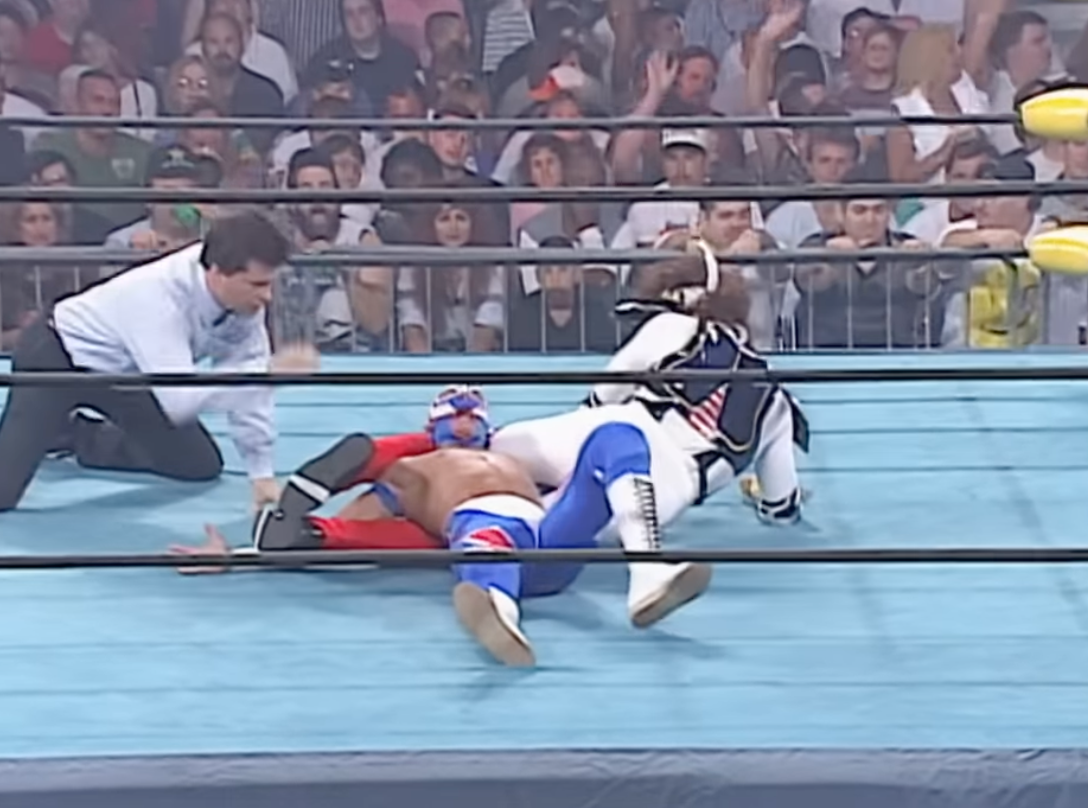
They start things methodically, working llave holds while some of those fans find their seats, Psychosis’ inverse cross-armbreaker deal — honestly something I’m shocked a wrestler hasn’t stolen as a signature submission! fuckin’ do some pushups while you’re cranking on that thing like lucha Scott Steiner, brother — stretching Rey out in the center of the ring, establishing Psychosis’ size advantage and Mysterio’s cleverness in slipping out of his holds. Within minutes — less than three of them, in fact — Mysterio’s out on the floor and gets crushed by an absolutely psychotic suicide dive. You hear a single woman scream like she’s witnessing a murder, and just like that, Rey and Psychosis have them.
They never let go. The buzz builds as Psychosis starts working his guillotine leg drop into the match, and when he lays Mysterio out with a clothesline and taunts the crowd, someone stands up to hit the slicing-the-air taunt back at him. Every time Rey takes a big bump, they groan in sympathy. When he slips out, there’s a pop of awe. Then Rey monkey flips Psychosis into the Carson City Silver Dollar Pole Match pole and they flip. Within eyeshot, a sign that reads “LUCHA LIBRE: WCW STYLE.”
You’re goddamn right.
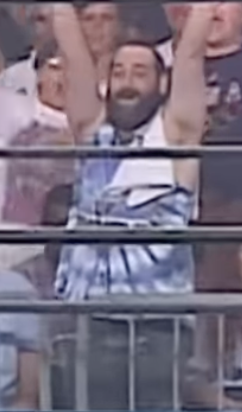
On commentary, Mike Tenay correctly pronounces “hurricanrana” for what’s maybe the first time (it can’t possibly be more than five, frankly — other WCW commentators are gonna be calling that one the Frankensteiner, and Joey Styles is on that hootandcanrana life to this day) as Mysterio hits two in succession that have probably lived in the brains of a few hundred of the people at the Ocean Center for some 30 years. There’s a dude dead-center in the hard cam in a Liquid Blue tie-dye tank top of some sort — Grateful Dead, I’m willing to guess — beaming like he’s witnessed the birth of a child. Two guys on the right who’ve been chatting while copping a lean against the guardrail are also standing, thinking they’ve seen the finish. Rey Mysterio is still working great wrestling matches in 2026 — respectfully, these people haven’t seen shit just yet.
Rey wisely works on Psychosis’ leg from here, but he’s still at his mercy somewhat due to the disparity in size between them. It’s fun watching him pick at it with dropkicks and deathlocks. It’s more fun to watch Psychosis hurl him into the air off an Irish whip, turning around to admire his handiwork as Mysterio lands on the top rope with his gut. Another woman in the crowd screams. THEY HAVE THESE PEOPLE, Y’ALL.
They have me, too. Especially Psychosis. He’s an early highlight of the WCW Cruiserweight division, a relentlessly bullying force who was absurdly giving when it came to his own body — the reason why this match works as well as it does in establishing Rey is because Psychosis is so exceptional in smothering him, in providing a seemingly insurmountable challenge. That his star doesn’t burn as brightly as Mysterio’s is probably down to a combination of racism (or, more politely, “the language barrier”), personal issues, and the WCW Cruiserweight Division beyond its ace entering something of a perpetual white boy summer, with 1996 belonging to Malenko, 1997 belonging to Syxx and Chris Jericho, 1998 belonging to Malenko and Jericho, and 1999 to Billy Kidman.
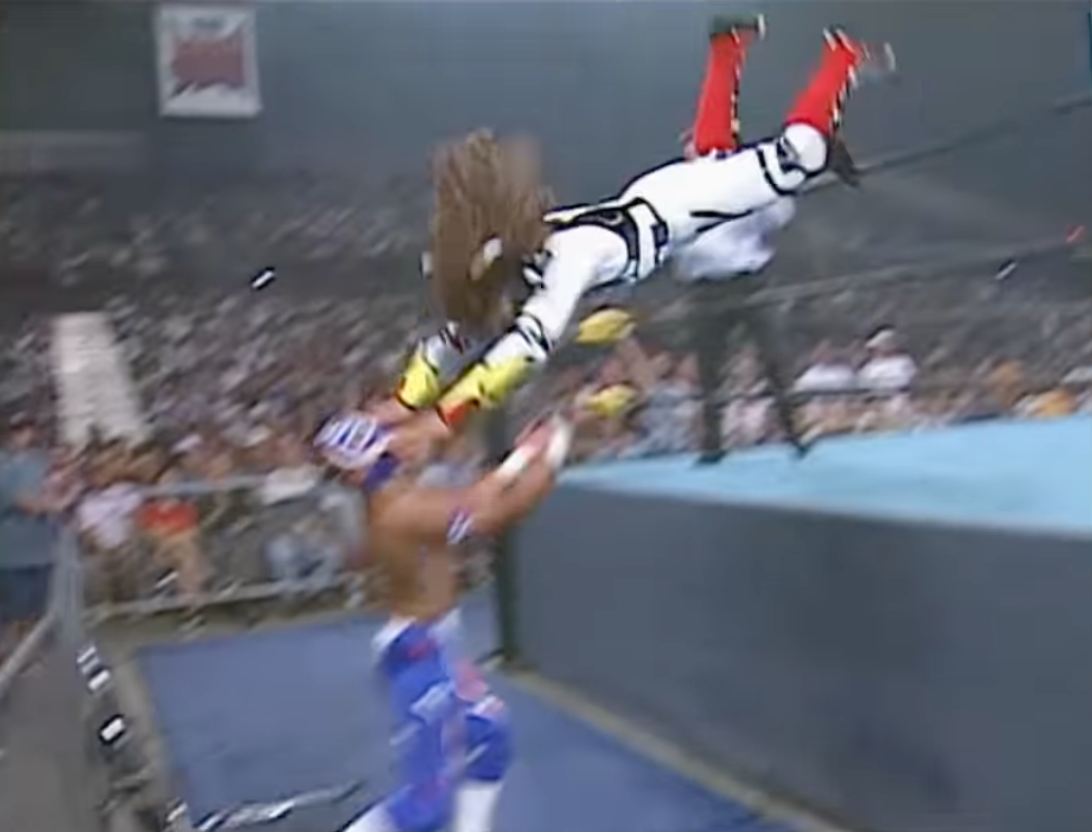
But here it feels like Mysterio and Psychosis are opening the floodgates. Soon after, other great matches pour in, like Mysterio’s bout against Super Calo at Fall Brawl, a half dozen sprints against Juventud Guerrera across WCW Television, and dream bouts against Ultimo Dragon and Jushin Thunder Liger. Until I watch the Calo match again, with its phenomenal double springboard hurricanrana that has to be the most inventive use of WCW’s multi-ring setups outside of a WarGames match, this is the best of the bunch. It’s absurdly fresh, immediately establishing Mysterio as one of the premiere babyfaces of the greatest wrestling promotion I’ve ever known. Bash at the Beach ends in tragedy — Hulk Hogan, you can go to hell — but it begins in triumph, move after spectacular move, dive after mind-bending dive. Motherfuckers are headbanging off of a counter Liger Bomb, y’all. By the time it ends, you come to know why Rey Mysterio has had surgery, to quote the ad, five times on his left knee, and you come to know a little about lucha libre. In the 30 years since, this match has opened charted dozens of new pathways of my journey as a wrestling fan, and, as I type “Rey Mysterio Psychosis chain match” into the YouTube search bar to see what shakes out, that will remain true for as long as I have eyes for this great sport. The Carson City Silver Dollar Pole Match bangs, too.
Rating: **** & 1/2