Nasty Dreams: WarGames '94
While not quite the last classic WarGames match, the '94 Stud Stable/Rhodes & Nasties beef is one hell of a ride.

I have, over the years, made my feelings about the 1994 WarGames match pretty clear. Words like “favorite” and “best” have tumbled out of me on the subject of the match itself, the angle leading to it, and, of course, the exrtraordinarly, otherworldly power of Dusty Rhodes’ famous “The View Never Changes” promo. But I’ve never written a full piece about the match itself before, and in choosing to do so here on BIG EGG, a match review website where I mostly try to keep things focused to the action between the bells, I have challenged myself to do so in a way that doesn’t truly feel possible, as divorced from the context that months of television and years of my life as a fan will allow. I am going to try, but first I need to divest myself of as much of that context as possible.
The story of this match, the axis upon which it turns — the mended relationship between Dusty Rhodes and his son Dustin — so closely models the one I wish I had with my own father that it hurts to think about. My dad, whom I shared a name with for most of my life, isn’t the most eloquent man, he isn’t someone I’ve held up as a role model for myself, but the distance between the two of us — a consequence of his and my mother’s divorce when I was very young — is a yawning gap at the core of my being, something that’s been exacerbated over time by my being a bookish and conflict-averse kid, by my moving away from home for college, by the walls I built between myself and most of the people I knew before I moved to Georgia so I could feel safe enough to transition, by his politics (which are, like the politics of many white, working class men of his age, informed by a lack of civil engagement and a constant stream of talk radio and Fox News), and our mutual inability, even after ending a years-long period of estrangement, to talk to each other about any of it. I have been waiting, in vain, for the moment when my dad says “I neglected you,” and it will probably never come.
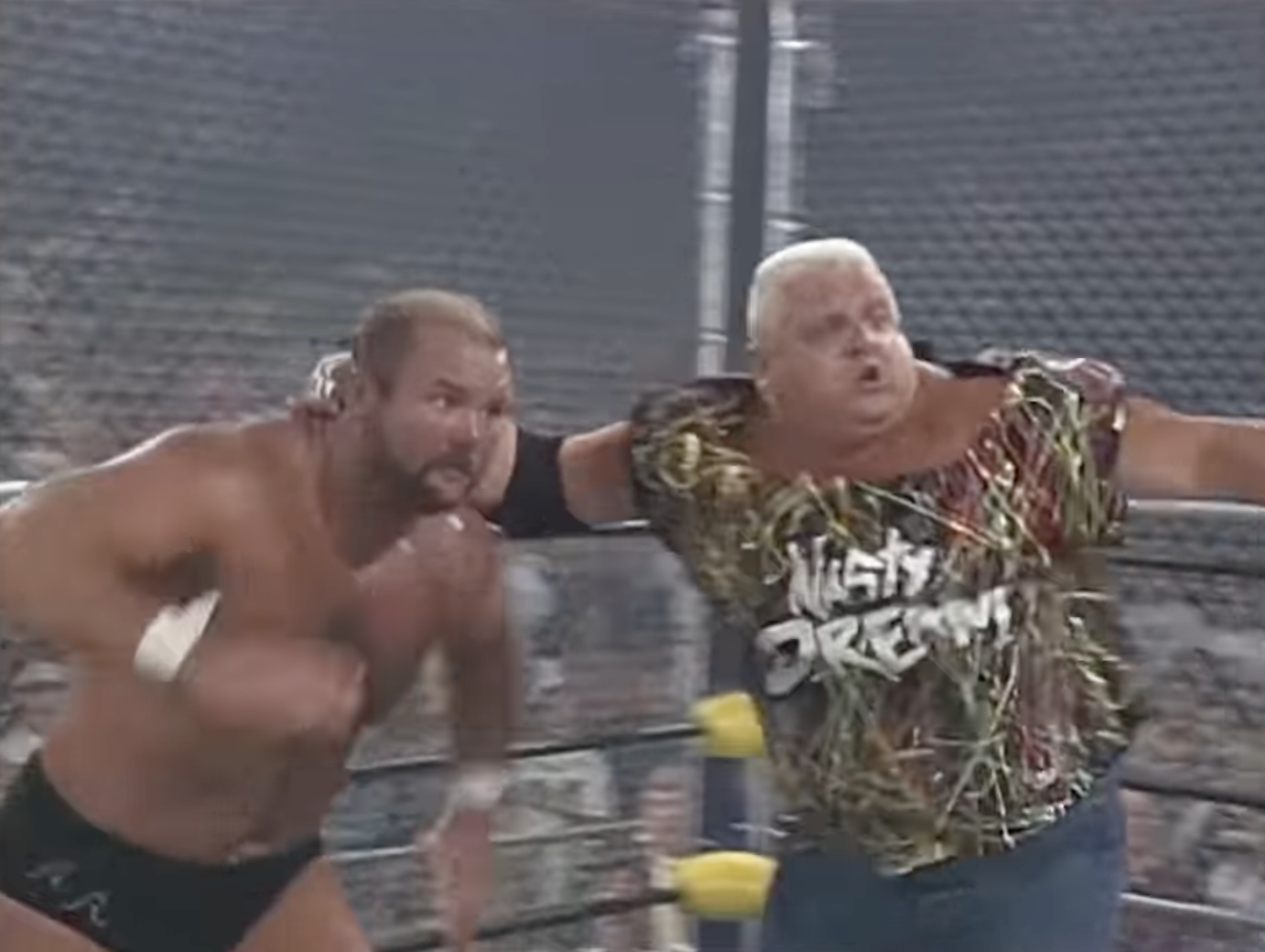
But I have this angle, you know? The one where Dustin Rhodes, the goddamn Natural, an obvious future WCW World Heavyweight Champion if ever there was one, finds himself on the wrong side of betrayal and injustice, alone without a friend in the world to spare him from the likes of Arn Anderson and Terry Funk — eternal enemies of his family line — and a bunch of other goons who are more than happy to put the boots to Dustin supposing the money’s right and the cause isn’t righteous. Enter the vengeful father. Enter the aging gunslinger. Enter, in Dusty Rhodes, two of the most potent fantasies in American fiction, armed with a silver tongue and a bionic elbow. You could pick any six wrestlers in the WarGames cage with Dusty and Dustin Rhodes and I would be just as invested, my love of them would still burn white hot. This is what I am trying to leave at the door, just like Col. Robert Parker has to leave Meng at the door.
Arn and Dustin start this one, obviously. Arn betraying Dustin is what got us here, but also besides Dusty nobody else is as seasoned at WarGames as these two are, and nobody is as savvy as Anderson when it comes to remaining a threat while playing the coward. The way the two of them move around the cage shows off how confining its environs are in a way that’s different than, say, Sid gorilla pressing Flyin’ Brian into the ceiling, Arn shifting from ring to ring while Dustin gives chase over the turnbuckles and through the ropes. Anderson’s chess game doesn’t work, as Rhodes finally catches him and batters him, hurling him into the cage and twisting his neck in the gap between the two. His diving lariat over two sets of ropes is incredibly impressive. This is a world champion, y’all. Goddamn you, Hulk Hogan.
This first period is so smart. It gives you what you want out of Dustin and Arn throughout the first three minutes, Dustin basically showing off as he dominates Arn until he makes a small mistake and Anderson plants him with a DDT. There are a lot of wrestlers who’ve laid claim to the DDT, but Arn Anderson is my favorite practitioner, even over Jake Roberts. Roberts, I think, suffers a bit because the WWF as a company relished in the set-up to a signature move, it got the crowd pumped and screaming for the finish, which was even more true when he was a babyface. In WCW, where Anderson was almost always a heel, the DDT was a comeuppance, something he’d plant a babyface with just as they were sure of victory, or, even better, when they flinched. He hits Dustin at about the three minute mark, two minutes before the coin toss to see which team will get the man advantage, which means he’s working heat on Dustin before Parker wins the coin toss. Rhodes gets a bit of a hope spot, controlling Anderson in a half crab as ring announcer David Penzer counts down to the toss, but it’s all for naught when Parker wins and sends in Bunkhouse Buck.
In isolation, the biggest issue this match has is that, between Arn and Dustin starting the match and Dusty coming in as the closer, nobody here, including Terry Funk, gives you much to sink your teeth into emotionally. The Stud Stable is a gang of hired mercenaries doing business for a Tom Parker-esque showbusiness promoter, and the Nasty Boys were enticed into this match by the Rhodes family with the promise of a PPV payday. Despite the fact that every wrestler here was either on my Greatest Wrestler Ever ballot (Funk, Arn, Dustin, and Dusty) or is someone I believe to be highly underrated (the Nasty Boys, the Golden Brothers, Meng), the swings in momentum as each new man enters don’t have the same bite as peak WarGames. The connection between these men — particularly the Nasty Boys and everyone else — is so tenuous that the middle segments stray into filler territory pretty quickly.
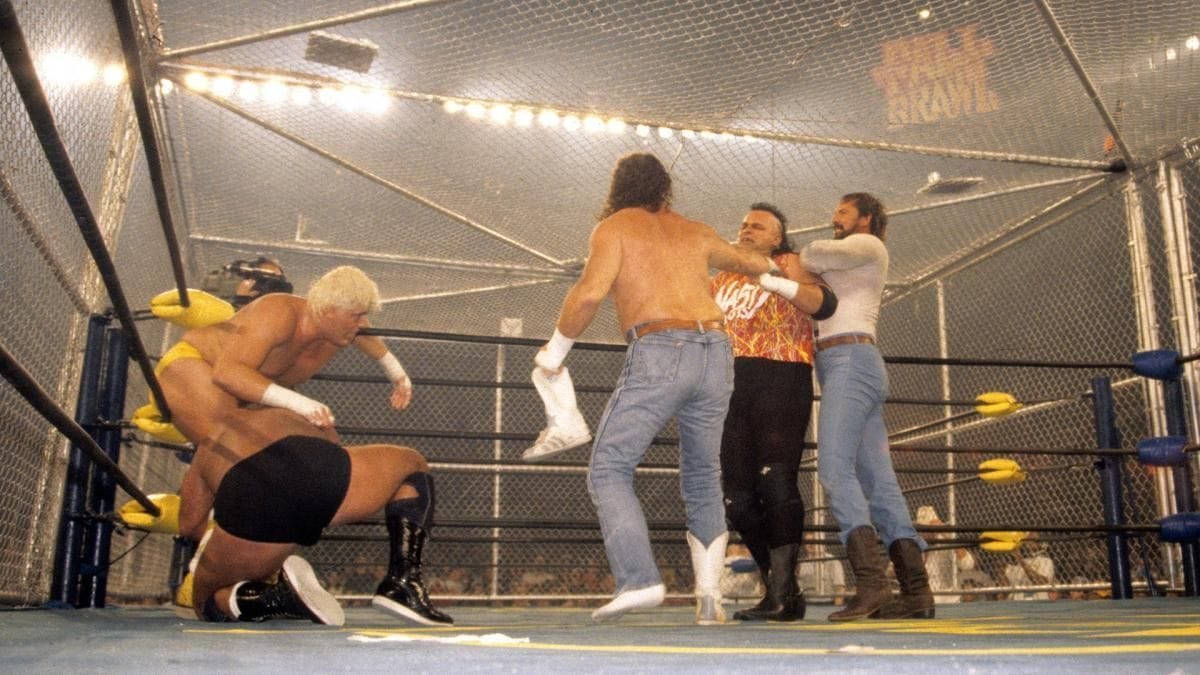
This match has the reputation of being the last of the classic WarGames matches, but really it’s the model for future ones, particularly AEW’s early Blood and Guts matches, where teams were formed over the course of segments aired on television but never given time to gel in the ring. That is, I think, the nature of WCW’s model shifting towards a more television-and-PPV focused product under the direction of Eric Bischoff, straying away from its initial function as the drawing card of an arena show tour. In a 2021 Fanfyte article that previewed the Pinnacle vs. Inner Circle Blood and Guts match, I noted that the 1987 Four Horsemen, the villains of the match, teamed together in one configuration or another 29 times where the Pinnacle teamed together once. The Rhodes Family and the Nasty Boys fare better, but not by much: Dustin teams with his pops once, and the Nasties twice. The Stud Stable are a cohesive unit, but there’s no issue between them and the Nasties, who were feuding with Cactus Jack and Kevin Sullivan, then with Kevin and his brother Dave.
Do the Nasty Boys need a reason to fight, besides being nasty? I suppose not, but WarGames is always better when the answer to that question is “yes.” The peak touring WarGames matches brought a crew of babyfaces together to stop a four-quadrant threat to the NWA, as did the two superior PPV iterations at WrestleWar ‘91 and ‘92. The Four Horsemen and the Dangerous Alliance were threats to everybody, the way they wormed their way through the fabric of the company went deep, the alliances that formed to stop them were stitched together but represented the very best the company had to offer. The 1996 and 1997 WarGames matches that pit WCW and the Four Horsemen against the nWo are truer to the spirit of “classic” WarGames than this one, though they’re not as good. Here you have an old man and his son and a couple of guys they literally picked up at a bar going up against a crew of goons from a PG version of Road House. That sounds kinda awesome, and it is, but it’s a short road from this to Hulkamaniacs vs. Dungeon of Doom, or the one with the Shockmaster.
So far as empty calories go, the segments previous to Dusty’s entry are a lot of fun. I love that Jimmy Golden found his way into a semi-prominent role in a national wrestling promotion, and if anybody should be in a PG version of Road House, it’s the one wrestler who was in the R-rated real thing. It’s unfortunate that the Funker isn’t given more to do here, but he’s not long for WCW, leaving after Halloween Havoc ‘94 to start up in IWA: Japan, the road to the Kawasaki Dream laid out before him. What he does before Dustin cuts him off suggests that he would have been a menace in a WarGames more tightly focused on him, but the 1989 WarGames match, which focused on the Jim Cornette/Paul E. Dangerously feud, was on the same show as Funk/Flair, so what can you do? He knows he’s in this one because of the long-standing feud between he and Dusty, so he rams Dustin’s head into the cage right in front of the American Dream and chokes him out on the ropes, using the cage to give him leverage to stomp at the back of Dustin’s head. He also takes a fucking insane piledriver from Jerry Sags in the gap between the rings, falling through to the floor because why wouldn’t he? When he reemerges, he’s wielding a tool the ring crew used to put together the rings, and with Buck wishboning Sags’ legs, hits the Nasty Boy right in the dick.
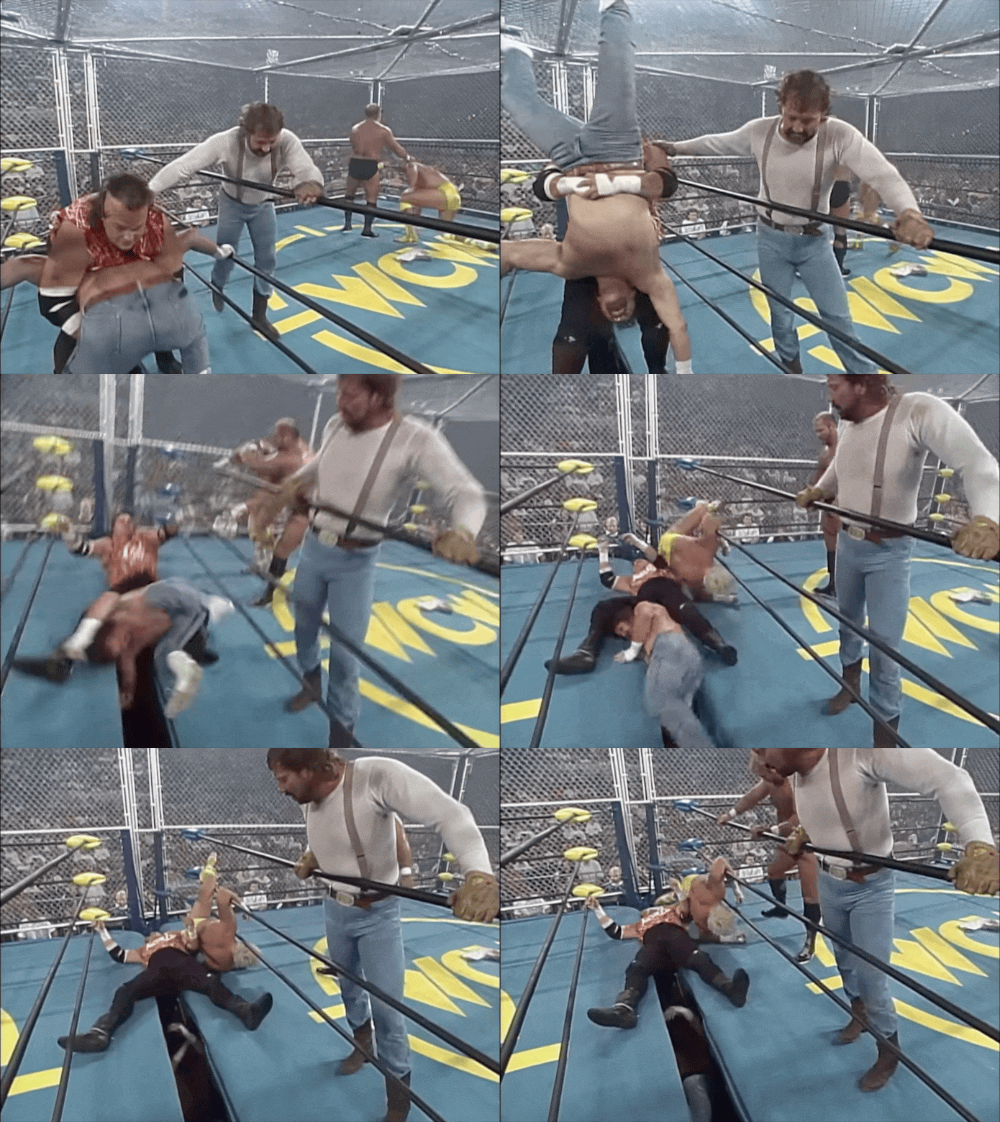
The formula of heat-hot tag-heat-hot tag works its magic, the crowd roaring every time a Nasty Boy comes to the rescue, because it’s a brilliant one, and because the crowd knows that with each entrant we’re closer to seeing Dusty get in the ring. Because the final man for the Stud Stable is Col. Parker, who has been flop sweating this whole time, his men have largely crumbled — even when Bunkhouse Buck regains the advantage for the Stud Stable by using a belt, Dustin’s off in the corner wearing out Terry Funk with one of his own. They finally do regain the advantage, just in time for the countdown to Dusty’s arrival to begin in earnest, a huge “DUSTY! DUSTY!” chant rising to meet him that would have had Hulk Hogan conspiring to get Dusty Rhodes out of WCW if he bothered to watch the shows he wasn’t on. This is the last gasp of WCW, Dusty Rhodes throwing ‘bows as a southern crowd greets each one with a “BOOM!” It’s an emotional frenzy you want to live in forever, but the point of this being the swift destruction of the coward Robert Parker, it’s over in a flash. In a way, it’s a perfect encapsulation of WCW: even at an ostensible peak, there’s another, higher one left unsummited, cards left on the table, juice left to squeeze. Had I rewatched “The View Never Changes” I’d be pounding out five asterisks through a veil of tears. Alas. WarGames ‘94 is still great, but there are two dry eyes in this house.
Rating: **** & ¼